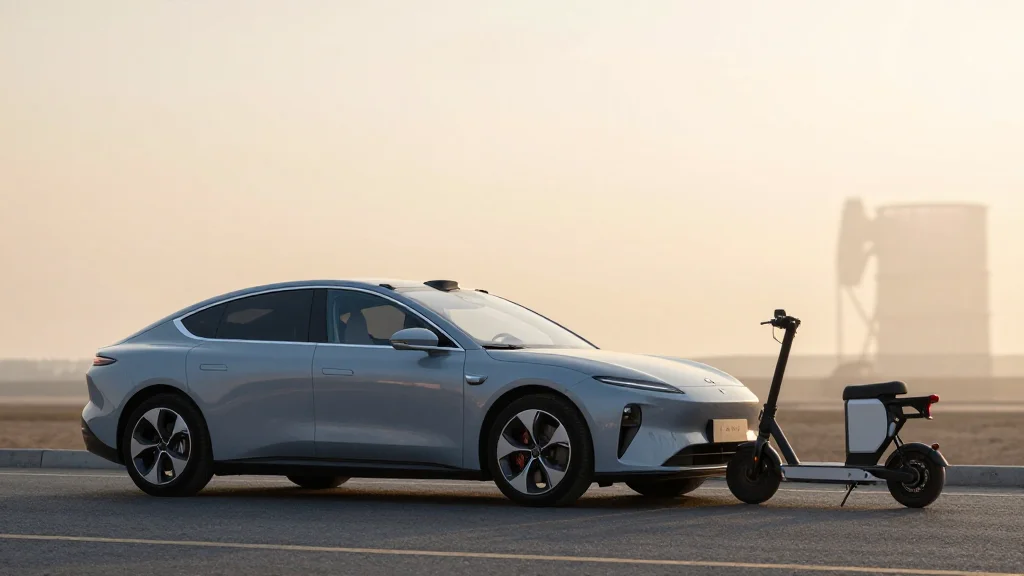
EVs Slashed Global Fuel Consumption Massively In 2025
Companies Mentioned
Why It Matters
The scale of oil displacement reshapes global energy demand, accelerating the transition away from fossil fuels and reinforcing policy incentives for electrification. It also creates measurable economic and health benefits that strengthen the business case for EV adoption.
Key Takeaways
- •EVs and PHEVs cut 2.3 M barrels of oil daily in 2025.
- •Two‑ and three‑wheelers accounted for nearly half of daily oil displacement.
- •Global plug‑in vehicle sales hit 20.7 M units, up 20% YoY.
- •BNEF forecasts 5.3 M barrels per day displaced by 2030.
- •Reduced oil use improves public health and lowers total cost of ownership.
Pulse Analysis
BloombergNEF’s latest analysis shows that electric vehicles (EVs) and plug‑in hybrids avoided the equivalent of 2.3 million barrels of crude oil per day in 2025. That figure translates to roughly 96 million barrels a month, or more than 1.1 billion barrels annually, underscoring the rapid decarbonization of road transport. The bulk of the avoided oil came not from passenger cars but from two‑ and three‑wheelers popular in Asian emerging markets, which alone displaced 1.1 million barrels daily. Even the more cautious Ember estimate confirms that EVs already offset a substantial share of global oil consumption.
The underlying driver is a surge in plug‑in vehicle sales, which hit 20.7 million units in 2025—a 20 % increase over the previous year. Growth was strongest in China, Europe and India, where supportive subsidies and expanding charging infrastructure have lowered adoption barriers. While motorcycles and scooters dominate the displacement today, BloombergNEF expects passenger cars to take the lead, projecting daily oil avoidance to climb to 5.3 million barrels by 2030 as battery costs fall and range improves. This trajectory threatens traditional oil demand forecasts and could prompt refiners to diversify toward petrochemicals or renewable fuels.
Beyond the headline oil numbers, the shift delivers tangible public‑health and economic benefits. Studies link higher EV penetration in California and New York to measurable reductions in particulate matter and nitrogen oxides, improving air quality for millions. From a consumer perspective, electricity costs per mile remain well below gasoline, and total cost of ownership—including lower maintenance and fuel expenses—often favors EVs, especially in regions with high fuel prices. Policymakers are therefore incentivized to accelerate electrification through tighter emissions standards and expanded charging networks, reinforcing a virtuous cycle that further erodes oil demand.
EVs Slashed Global Fuel Consumption Massively In 2025
Comments
Want to join the conversation?
Loading comments...