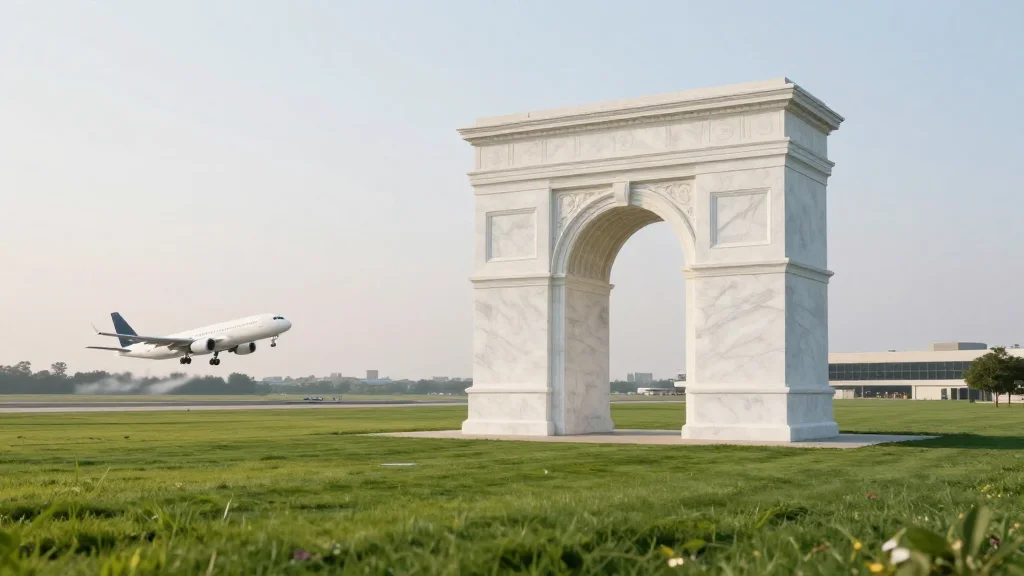
FAA Evaluating Airspace Risks From Proposed “Triumphal Arch”
Why It Matters
The arch could compromise critical flight paths in one of the nation’s most congested airspaces, prompting stricter oversight that may affect future construction near airports. Its review also reflects heightened safety vigilance after a recent high‑profile mid‑air collision.
Key Takeaways
- •FAA reviews 250‑ft arch less than 2 miles from DCA.
- •Potential obstruction could affect instrument approach procedures.
- •Helicopter routes in National Capital Region may require adjustments.
- •Review follows 2025 mid‑air collision prompting stricter airspace oversight.
Pulse Analysis
The 250‑foot “triumphal arch” championed by former President Donald Trump has ignited a regulatory flashpoint in the nation’s capital. Planned within two miles of Ronald Reagan Washington National Airport, the monument would rise into the Class B airspace that shields the busiest terminal in the region. The Federal Aviation Administration, tasked with preserving unobstructed flight paths, has launched a preliminary safety assessment that examines obstruction clearance, line‑of‑sight limits, and the arch’s impact on both fixed‑wing and rotorcraft operations. Any deviation from established standards could force redesign or height reductions.
Washington’s airspace has been under a microscope since the 2025 collision between an American Airlines regional jet and an Army Black Hawk, an incident that exposed gaps in coordination between civilian and military traffic. That accident prompted the FAA to tighten instrument procedure reviews and to scrutinize any new structures that could compromise the tightly choreographed arrival and departure corridors. The agency’s evaluation framework now incorporates advanced simulation modeling, radar signature analysis, and stakeholder input from airlines, the National Guard, and local authorities, ensuring that safety margins remain robust.
The outcome of this review will set a de‑facto precedent for future infrastructure projects near major airports. Developers of high‑profile monuments or skyscrapers will likely face earlier, more detailed obstruction assessments, potentially increasing project timelines and costs. Moreover, the political dimension—linking a symbolic structure to national heritage—adds pressure on regulators to balance public sentiment with operational safety. For the aviation industry, a decisive FAA ruling reinforces the primacy of airspace integrity, signaling that even politically charged projects cannot bypass rigorous safety protocols.
FAA Evaluating Airspace Risks From Proposed “Triumphal Arch”
Comments
Want to join the conversation?
Loading comments...