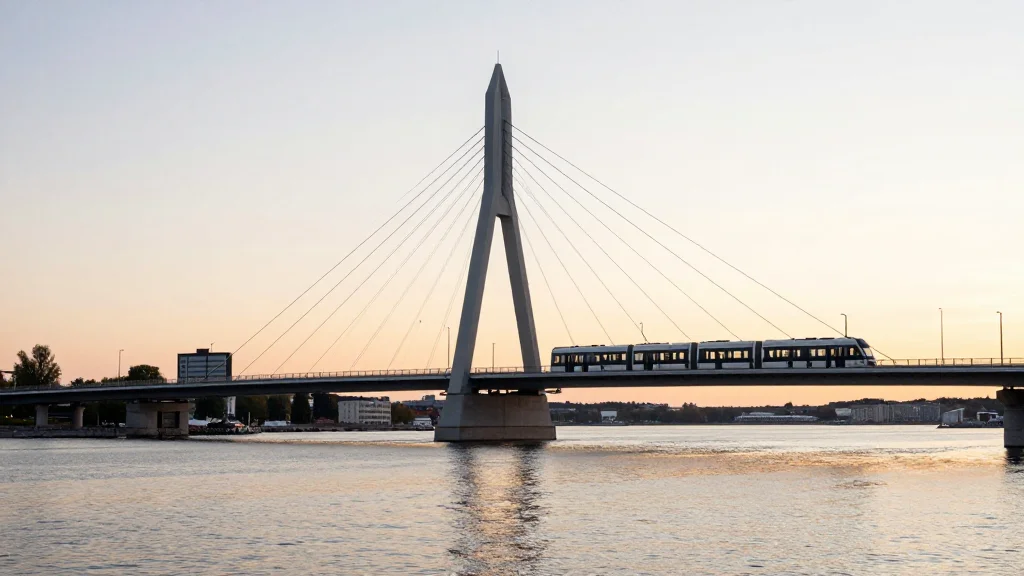
Finland’s Longest Bridge Opens to 50,000 Visitors in First Weekend
Why It Matters
By prioritizing public transit and active mobility, the bridge supports Helsinki’s climate goals while creating a new landmark that can boost tourism and spur economic growth in emerging districts.
Key Takeaways
- •Bridge spans 1,191 m, becoming Finland's longest and tallest crossing.
- •Excludes private cars, dedicating space to trams, pedestrians, cyclists.
- •Expected 23,000 daily tram riders and thousands of cyclists by 2030.
- •First weekend attracted 50,000 visitors, signaling strong tourism potential.
Pulse Analysis
Helsinki’s decision to build a 1.2‑kilometre, car‑free bridge reflects a broader shift in urban planning toward people‑first infrastructure. Unlike traditional highway‑oriented crossings, Kruunuvuorensilta integrates a tram line, pedestrian walkways and cycling lanes beneath a striking 135‑metre pylon, echoing projects such as Copenhagen’s Cykelslangen and London’s Millennium Bridge. By embedding mass transit into a landmark structure, the city not only improves connectivity between the centre and the rapidly growing Laajasalo island but also positions itself alongside European leaders that use iconic bridges to reinforce sustainable mobility narratives.
The bridge’s debut weekend drew more than 50,000 visitors, instantly proving its pull as a tourism magnet. As destination branding becomes a competitive edge, Helsinki can leverage the bridge’s panoramic views and photo‑friendly design to attract experiential travellers seeking urban landmarks. Early estimates suggest the structure could generate additional visitor spending in nearby districts, supporting local businesses and encouraging further development of Kruunuvuorenranta. Moreover, the bridge’s capacity for events—from marathons to cultural festivals—adds a versatile revenue stream that extends beyond its transport function.
Sustainability lies at the core of Kruunuvuorensilta, which was engineered for a 200‑year service life and carries an estimated carbon footprint of 129,000 tCO₂e. The project employed low‑carbon concrete, renewable‑energy construction practices, and innovative ice‑mitigation cables that reduce maintenance emissions. By halving the travel distance between central Helsinki and Laajasalo from 11 km to roughly 5.5 km, the bridge is expected to shift thousands of trips from cars to trams, bicycles and foot traffic, directly supporting the city’s target to cut transport‑related emissions and meet its 2030 climate objectives.
Finland’s Longest Bridge Opens to 50,000 Visitors in First Weekend
Comments
Want to join the conversation?
Loading comments...