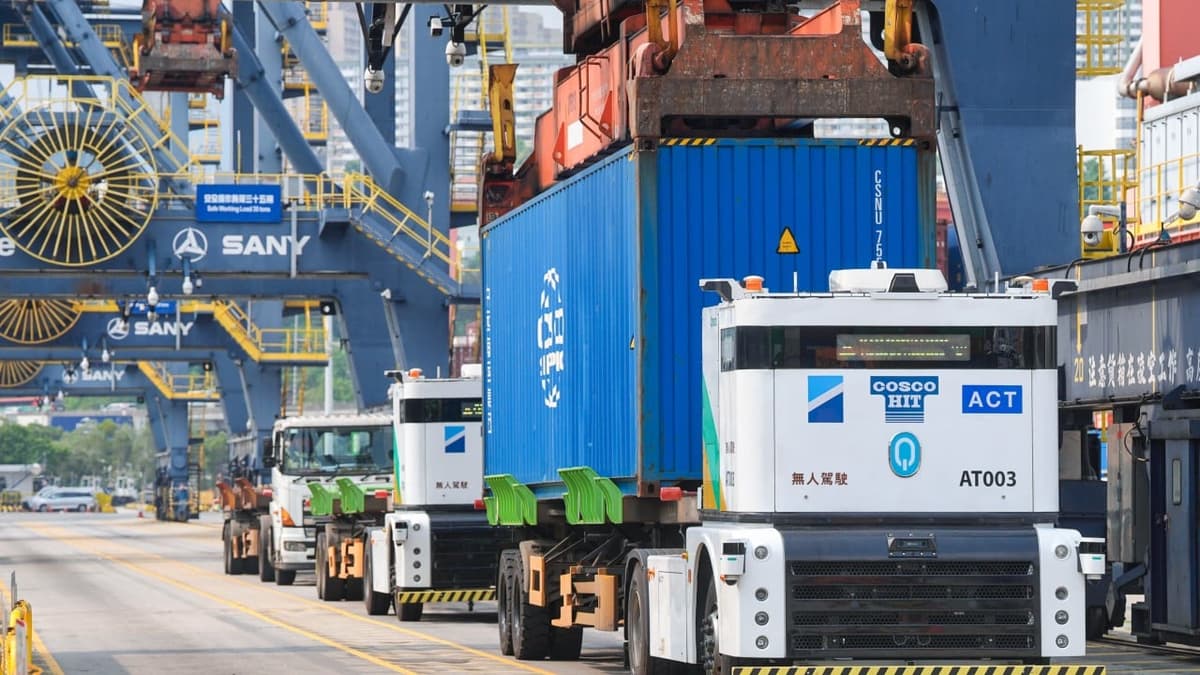
First AI Driverless Trucks Deployed to Tackle Hong Kong Port Labour Shortage
Companies Mentioned
Why It Matters
The deployment directly addresses Hong Kong’s labor crunch in port logistics, boosting throughput while reducing reliance on scarce human drivers. It also showcases how AI and 5G can transform freight handling, setting a precedent for wider automation in Asian supply chains.
Key Takeaways
- •Six autonomous electric trucks moved 8,000 containers since January.
- •Driverless trucks share lanes with conventional vehicles, no dedicated lanes needed.
- •AI routing and 5G connectivity boost port efficiency amid labor shortage.
- •Trucks charge one hour daily; future battery swaps cut downtime to minutes.
- •Plans to expand driverless fleet across all Hutchison terminals.
Pulse Analysis
The chronic shortage of commercial‑vehicle drivers has become a bottleneck for Hong Kong’s bustling container terminals. To counter this, Hutchison Port Holdings Trust rolled out a fleet of six electric autonomous trucks at Kwai Tsing Container Terminal 4, handling more than 8,000 container moves since January. By allowing driverless trucks to operate on the same roadways as conventional vehicles, the port sidesteps the costly construction of dedicated lanes while immediately freeing up scarce human resources. The deployment marks the city’s first large‑scale AI‑driven freight solution.
The trucks rely on a suite of AI algorithms, dual‑camera vision, laser radar and an advanced positioning system to navigate in “mixed mode” traffic. Real‑time data streams travel over a dedicated 5G network, delivering sub‑second latency that enables instantaneous route recalculations when obstacles appear. Each vehicle charges for roughly one hour per day, but Hutchison plans to introduce swappable battery packs that can be exchanged in six to seven minutes, dramatically reducing idle time. Centralized fleet management integrates the autonomous units with the port’s yard‑management and CCTV infrastructure for layered safety oversight.
Beyond the immediate productivity gains, the rollout signals a broader shift toward automation across Asia’s supply‑chain corridors. As mainland Chinese firms such as Baidu scale autonomous taxi and freight services, Hong Kong’s ports are positioning themselves as early adopters, potentially reshaping labor dynamics for thousands of drivers. While the technology promises lower operating costs and greener operations, it also raises questions about workforce transition and regulatory frameworks. Hutchison’s plan to extend driverless trucks to all its terminals suggests that autonomous freight may soon become the industry norm rather than an experimental niche.
First AI driverless trucks deployed to tackle Hong Kong port labour shortage
Comments
Want to join the conversation?
Loading comments...