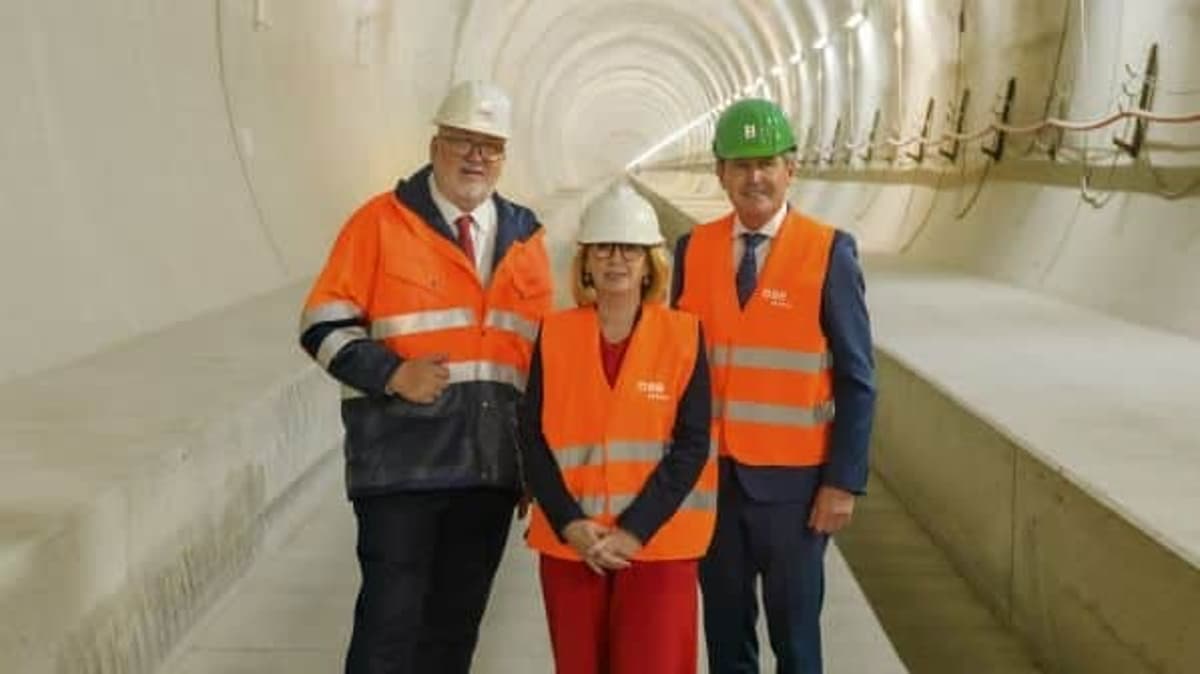
First Passage Through Austria’s Semmering Base Tunnel
Why It Matters
The tunnel will dramatically shorten travel times and increase freight capacity on a key Central European corridor, boosting economic productivity and supporting EU climate‑shift goals. Its completion also reinforces Austria’s strategic position in the trans‑Alpine rail network.
Key Takeaways
- •27.3km Semmering Base Tunnel completed after 15 years
- •First official road traversal marks milestone before train service
- •Tunnel to cut Vienna‑Graz travel to 1h 50m by 2029
- •Construction of technical equipment and lining will take three years
- •Designed for 230 km/h, replacing 60‑80 km/h legacy line
Pulse Analysis
The 27.3‑kilometre Semmering Base Tunnel is the latest Alpine breakthrough in Europe’s push for high‑speed, low‑gradient rail corridors. After nearly 15 years of drilling, the twin‑bore tunnel links Lower Austria’s Gloggnitz with Styria’s Mürzzuschlag, bypassing the steep, curvy legacy line that has constrained speeds for decades. Its completion follows a wave of trans‑Alpine projects such as the Gotthard Base Tunnel, reinforcing Austria’s role as a north‑south freight conduit and a testbed for advanced tunnelling techniques.
Operationally, the tunnel promises to slash the Vienna‑Graz journey from 2 hours 36 minutes to roughly 1 hour 50 minutes, thanks to a design speed of 230 km/h versus the current 60‑80 km/h limit. Faster passenger services will attract business travellers and tourists, while the flatter profile enables heavier, longer freight trains, reducing reliance on road haulage across the Alps. Early estimates suggest annual time savings could translate into billions of euros in economic productivity and lower emissions for the Central European corridor.
Despite the milestone road passage, full service remains three years away as engineers install signalling, ventilation, power and the concrete inner lining in the Gloggnitz section and emergency shafts. The project’s phased contracts—track laying slated for 2025 and fit‑out awarded in 2024—illustrate a disciplined procurement strategy that mitigates cost overruns common in mega‑infrastructure. Once in operation, the Semmering Base Tunnel will complement the broader Alpine rail network, encouraging modal shift, supporting EU climate goals, and setting a benchmark for future base‑tunnel initiatives.
First passage through Austria’s Semmering Base Tunnel
Comments
Want to join the conversation?
Loading comments...