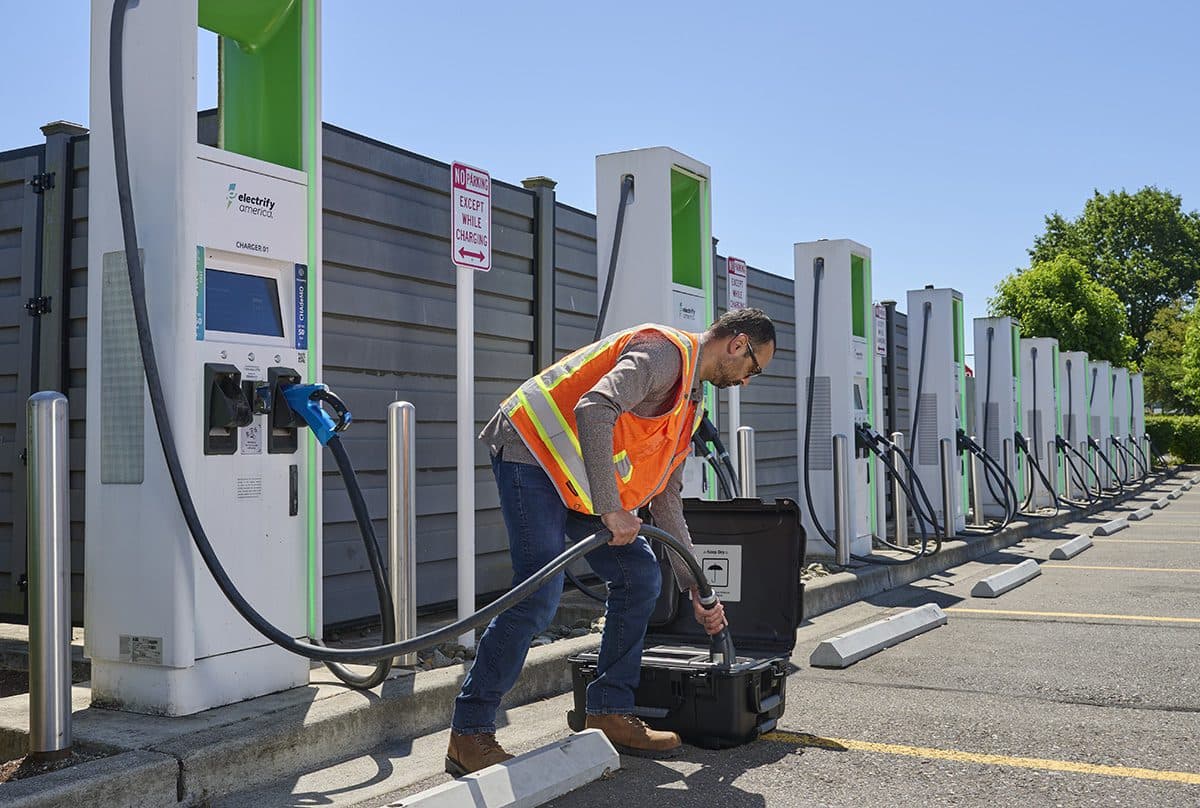
Fluke’s FEV500 Acts as a Virtual EV to Test DC Fast Chargers, Replacing Three Separate Instruments
Why It Matters
The tool can dramatically improve fast‑charger uptime and lower service costs, accelerating EV adoption and addressing the industry’s most vulnerable reliability link.
Key Takeaways
- •FEV500 replaces multimeter, insulation tester, oscilloscope
- •Simulates EV communication via ISO 15118 and DIN 70121
- •Enables pass/fail testing with guided workflows
- •Portable, rugged design with removable battery for field use
- •Targets 20% US fast‑charger downtime, improving reliability
Pulse Analysis
Reliability remains the Achilles’ heel of the United States’ growing network of DC fast chargers. While Level 3 stations deliver the high‑power bursts needed for long‑distance travel, they also require a complex digital handshake between the charger and the vehicle. Failures in this communication layer can render a station inoperable, contributing to the Harvard Business School study that estimates 20% of U.S. fast chargers are offline at any given time. Traditional testing approaches involve multiple instruments and often require a live EV, creating logistical hurdles and increasing labor costs.
Fluke’s FEV500 tackles these challenges by acting as a virtual electric vehicle. The handheld unit emulates the full protocol stack, validating both electrical parameters and the ISO 15118/DIN SPEC 70121 communication standards that govern charging sessions. Its single‑connection design eliminates the need for disassembly, while auto‑test sequences generate instant pass/fail outcomes and log data directly on the device. By merging the functions of a digital multimeter, insulation tester, and oscilloscope, the FEV500 reduces equipment inventory and shortens diagnostic cycles, enabling technicians with minimal training to perform comprehensive checks in the field.
The market implications are significant. Faster, more reliable commissioning and maintenance translate into higher charger availability, directly supporting fleet operators and consumer confidence in EVs. Operators can expect lower service expenses and reduced downtime, while manufacturers gain a standardized testing platform that aligns with global communication protocols. As the EV ecosystem scales, tools like the FEV500 will become essential infrastructure, helping to close the reliability gap that currently hampers the transition to electric mobility.
Fluke’s FEV500 acts as a virtual EV to test DC fast chargers, replacing three separate instruments
Comments
Want to join the conversation?
Loading comments...