
Companies Mentioned
Why It Matters
The change removes an unnecessary administrative step, speeding up commercial and hobbyist drone operations while preserving safety around police BVLOS missions.
Key Takeaways
- •CAA will add sentence to TDA NOTAMs confirming VLOS permission exemption
- •Police BVLOS trials use drone detection, ensuring they see civilian UAVs first
- •Operators can fly VLOS in TDAs without requesting CAA approval
- •Maintaining VLOS and using spotters enhances safety around police drone activities
- •Unnecessary permission requests caused six months of workflow friction
Pulse Analysis
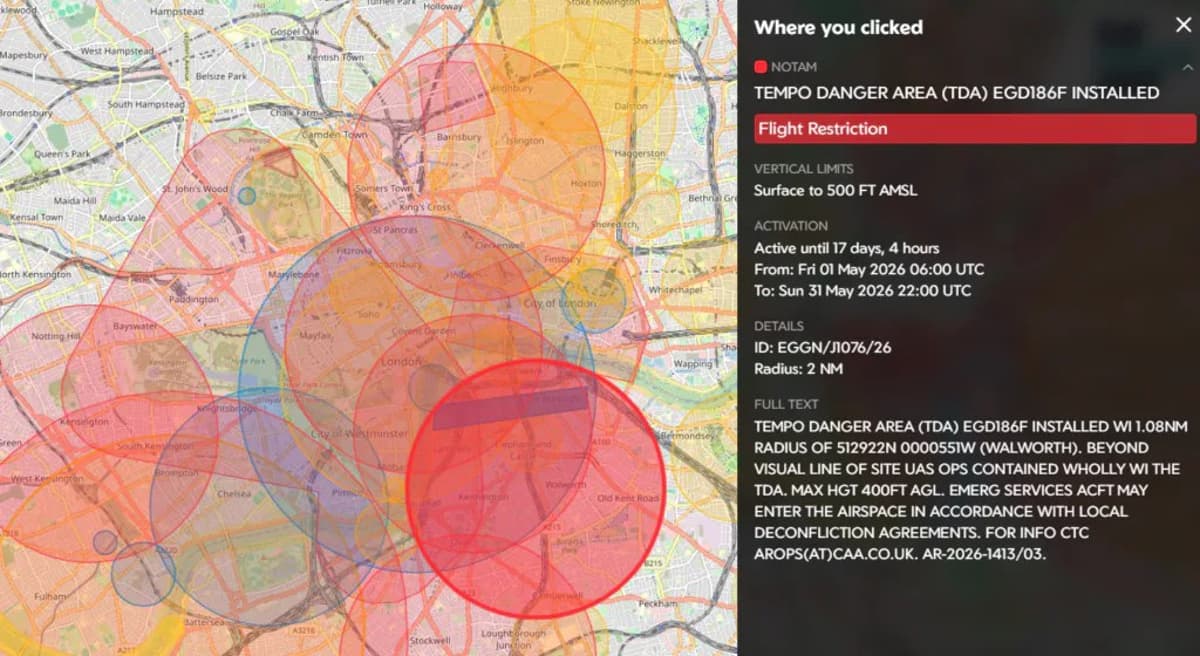
The United Kingdom’s Civil Aviation Authority (CAA) has been issuing Temporary Danger Areas (TDAs) to accompany the Metropolitan Police’s burgeoning beyond‑visual‑line‑of‑sight (BVLOS) drone trials. Over the past two years, these trials have expanded beyond London, prompting the CAA to publish NOTAMs that warn other airspace users of police‑operated unmanned aircraft. While the intent is safety, the requirement for operators to seek explicit permission to fly within a TDA has created unnecessary administrative friction, especially for pilots conducting visual‑line‑of‑sight (VLOS) flights that pose no direct conflict.
In response, the CAA announced a wording amendment to the D‑field of TDA NOTAMs, explicitly stating that VLOS operations may continue without a separate operating permission. This clarification aligns with the reality that police BVLOS missions are equipped with drone‑detection systems and maintain situational awareness of civilian UAVs, effectively reducing the risk of mid‑air encounters. For commercial and hobbyist pilots, the change eliminates a time‑consuming request process, allowing quicker mission planning while still encouraging adherence to existing visual‑see‑and‑avoid best practices.
The update marks a modest but meaningful step toward a more proportionate regulatory framework for emerging UAS use cases. By distinguishing between high‑risk BVLOS activities and routine VLOS flights, the CAA can focus oversight resources on truly hazardous operations, such as those involving kinetic payloads or densely populated corridors. Operators are advised to maintain strict VLOS discipline, employ spotters where feasible, and stay familiar with emergency procedures outlined in the PDRA01 Operations Manual. As BVLOS technology matures, similar nuanced guidance will be essential to balance safety with industry growth.
Flying in police BVLOS TDAs
Comments
Want to join the conversation?
Loading comments...