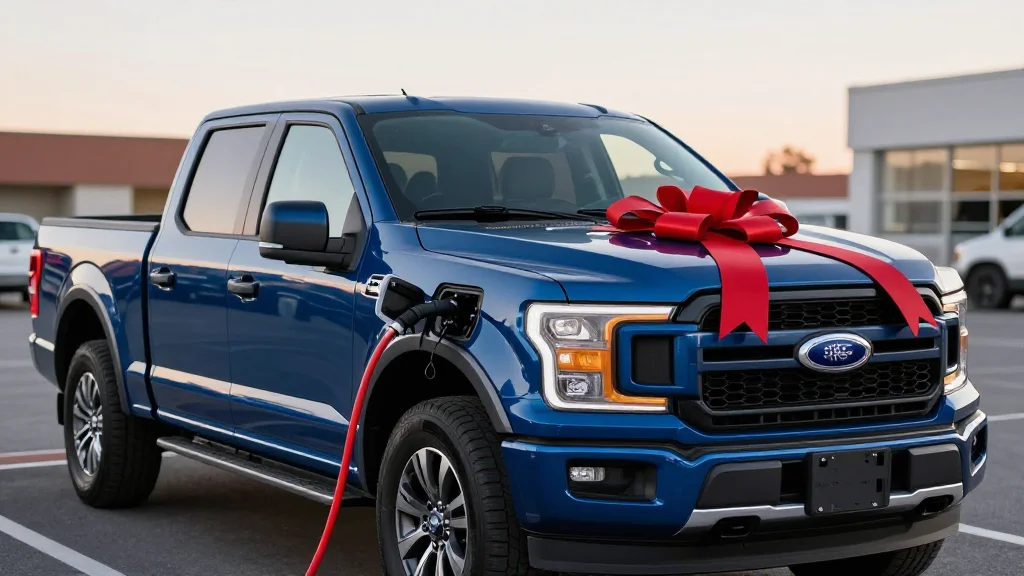
Ford’s ‘Employee Pricing For All’ Is Back. Here’s How Much You Can Save On EVs
Companies Mentioned
Why It Matters
By slashing prices and allowing incentive stacking, Ford hopes to arrest a steep decline in U.S. EV demand and improve dealer inventory turnover. The move signals that affordability will be a decisive factor in the next wave of electric‑vehicle adoption.
Key Takeaways
- •Ford revives “Employee Pricing For All” with up to $4,000 EV discount.
- •2025 Mustang Mach‑E price drops to $38,000, $1,990 below MSRP.
- •2025 F‑150 Lightning starts at $53,646, $4,134 under MSRP.
- •Additional incentives stack: up to $10,000 on Lightning, $7,000 on Mach‑E.
- •EV sales fell 61% YoY, prompting aggressive pricing strategy.
Pulse Analysis
Ford’s renewed "Employee Pricing For All" program arrives at a critical juncture for the automaker’s electric‑vehicle portfolio. After a 61% plunge in U.S. EV sales during the first four months of the year, the company is using direct price cuts—up to $4,000 off the MSRP of its Mustang Mach‑E and F‑150 Lightning—to make its offerings more competitive against rivals such as Tesla, Rivian, and emerging Chinese entrants. The discount strategy is complemented by stackable incentives, including up to $10,000 for Lightning buyers and $7,000 for Mach‑E purchasers, as well as 0% financing, creating a compelling total cost of ownership proposition for price‑sensitive consumers.
The pricing adjustments also address inventory pressures at dealerships. By lowering the sticker price to $38,000 for the 2025 Mustang Mach‑E and $53,646 for the 2025 F‑150 Lightning, Ford narrows the gap between its EVs and comparable gasoline models, potentially accelerating turnover of slow‑moving stock. The inclusion of a free Level 2 home charger and the Power Promise support package adds value beyond the purchase price, reinforcing brand loyalty and reducing range‑anxiety concerns that have hampered EV adoption.
Industry analysts view Ford’s move as a bellwether for the broader U.S. auto market, where affordability is emerging as the primary barrier to mass‑market EV penetration. If the discount program succeeds in stabilizing sales, it could prompt other manufacturers to adopt similar pricing tactics, reshaping the competitive landscape. However, sustained price erosion may compress margins, making cost‑control and supply‑chain efficiencies essential for long‑term profitability. Ford’s ability to balance lower prices with profitable volume will be a key indicator of whether aggressive discounting can revive the EV segment without undermining financial health.
Ford’s ‘Employee Pricing For All’ Is Back. Here’s How Much You Can Save On EVs
Comments
Want to join the conversation?
Loading comments...