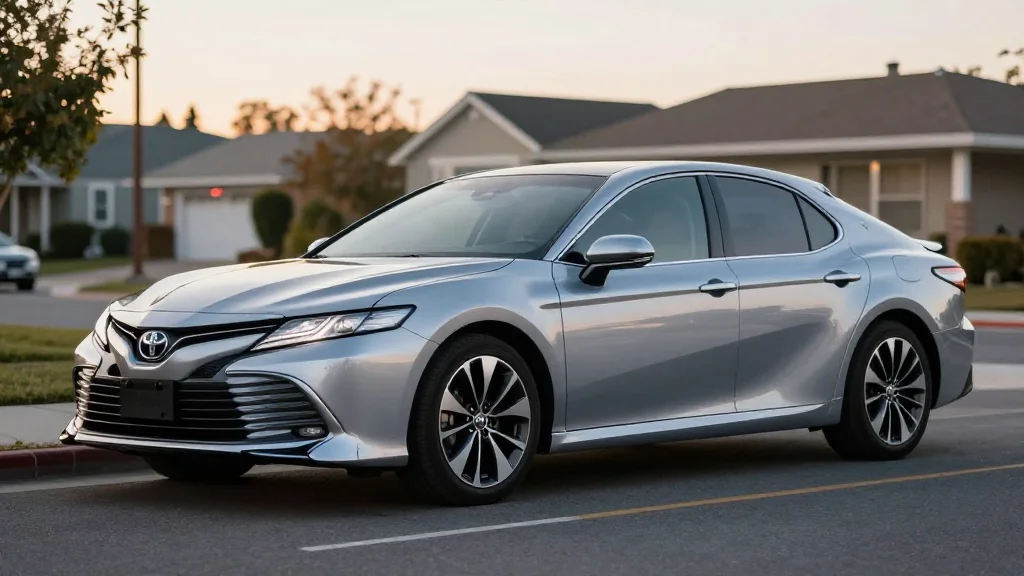
Forget the Toyota Camry—This Subaru SUV Costs Less to Own
Companies Mentioned
Why It Matters
The pricing and cost parity between the Uncharted and Camry signal that electric SUVs are now financially competitive with conventional sedans, accelerating the shift toward electrified family vehicles. This challenges legacy manufacturers to broaden their EV line‑ups or risk losing market share in the core family segment.
Key Takeaways
- •2026 Subaru Uncharted EV starts at $34,995, rivaling Camry price.
- •5‑year ownership cost of Uncharted ($32,100) is close to Camry ($30,824).
- •Uncharted’s city efficiency (129 MPGe) far exceeds Camry’s 46 mpg combined.
- •Cargo volume advantage: 25.4 cu ft vs Camry’s 15.1 cu ft.
- •Shift to compact SUVs pressures traditional midsize sedans.
Pulse Analysis
The family‑car market has been undergoing a quiet revolution for the past decade, as buyers trade the low‑profile sedan for a higher, more versatile crossover. The Subaru Uncharted epitomizes this trend: an electric compact SUV that fits comfortably into the price bracket once dominated by the Toyota Camry. Its taller stance and wider track translate into a roomier cabin and a cargo capacity that outstrips the Camry by nearly eight cubic feet, while its electric drivetrain delivers 129 MPGe in city driving—more than double the Camry’s fuel economy. This combination of practicality and efficiency meets the evolving expectations of urban‑centric families who value short‑haul convenience over long‑distance cruising.
When the numbers are crunched over a typical five‑year ownership horizon, the Uncharted’s total cost of $32,100 is remarkably close to the Camry’s $30,824, despite the EV’s higher upfront price. The gap is narrowed by substantially lower energy expenses—about $3,000 versus $6,500 for gasoline—and a modest maintenance premium of roughly $1,600 compared with $1,500 for the Camry. Depreciation remains a variable, with the Uncharted projected at 55‑65% loss of value, slightly higher than the Camry’s 43%‑45% range, but the overall cost balance suggests that electric SUVs can now compete on a total‑cost basis, not just on environmental credentials.
For manufacturers, the Uncharted’s market entry forces a strategic rethink. Toyota’s own electric C‑HR and bZ series aim to protect its sedan legacy, yet they sit at comparable or higher price points and often sacrifice interior space or range. Subaru’s aggressive pricing and efficient platform demonstrate that EVs no longer belong exclusively to the premium segment. As electric vehicle adoption accelerates and battery costs continue to fall, more automakers will likely follow suit, expanding affordable EV SUV options and further eroding the sedan’s once‑unassailable position in the family‑car hierarchy.
Forget the Toyota Camry—this Subaru SUV costs less to own
Comments
Want to join the conversation?
Loading comments...