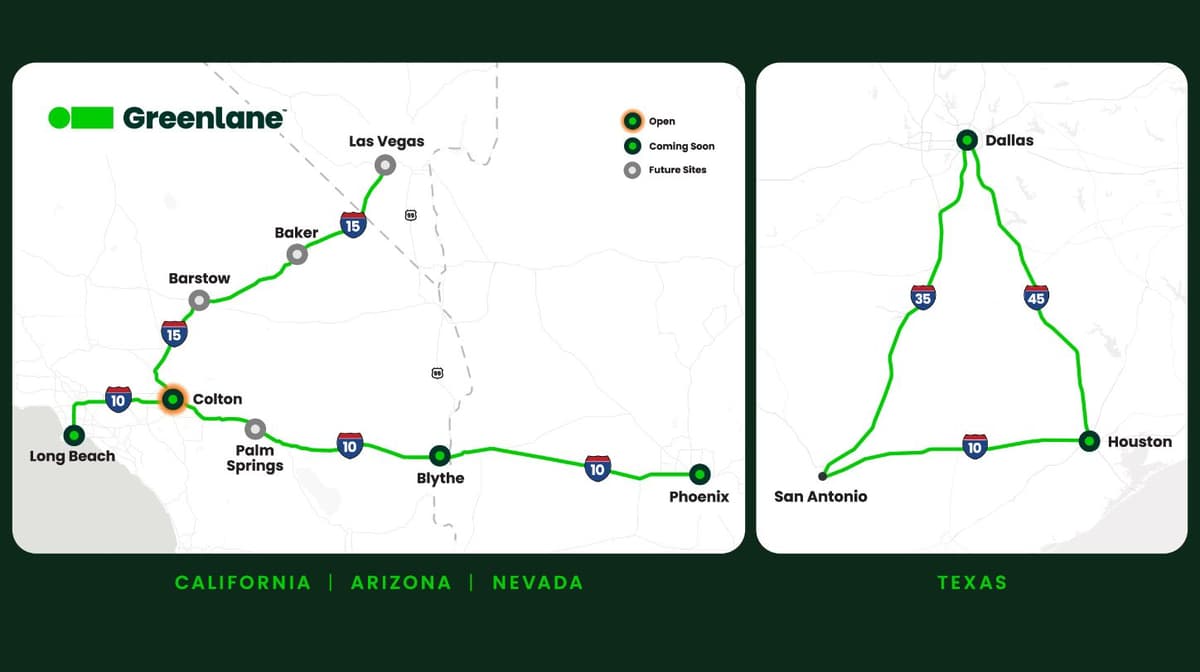
Greenlane Expands Electric Truck Charging Network
Why It Matters
The expansion gives fleets a reliable, high‑power charging option on one of the nation’s busiest trucking routes, accelerating electric‑truck adoption and reducing operational downtime. It also signals that demand‑driven charging networks are becoming essential infrastructure for long‑haul logistics.
Key Takeaways
- •Greenlane adds high‑power sites in Dallas and Houston.
- •Chargers support CCS and future‑generation MCS connectors.
- •6‑8 pull‑through lanes enable charging during driver rest.
- •Sites include parking for drop‑and‑hook and overnight stops.
- •Expansion follows demand‑driven strategy on a major freight corridor.
Pulse Analysis
The commercial electric‑truck market is reaching a tipping point, with major carriers pledging to electrify fleets to meet emissions targets and cost pressures. However, the lack of a robust, high‑power charging network has been a persistent barrier, especially on long‑haul routes. Greenlane’s move into Texas addresses this gap by targeting the Dallas‑Houston I‑45 corridor, a conduit for freight moving between the West Coast, the Midwest and the U.S.-Mexico border. By establishing charging hubs where traffic density is highest, the company not only captures immediate demand but also creates a template for future expansions across other freight corridors.
Technically, the new sites will install megawatt‑scale chargers capable of handling both combined charging system (CCS) plugs used by today’s electric trucks and the emerging megawatt charging system (MCS) standard for next‑generation models. This dual‑compatibility ensures that current fleets can plug in today while future vehicles are accommodated without retrofitting. The high‑power output is calibrated to match typical driver rest periods, allowing trucks to recharge in the same timeframe they would refuel with diesel, thereby eliminating extra dwell time and preserving route efficiency. Integrated pull‑through lanes and dedicated tractor parking further streamline the charging process.
Strategically, Greenlane’s demand‑driven rollout underscores a shift in logistics infrastructure: providers are aligning network growth with fleet commitments rather than speculative placement. For shippers, the availability of reliable charging on the Dallas‑Houston corridor reduces range anxiety and supports continuous, drop‑and‑hook operations, which can lower overall transportation costs. Competitors will need to match this level of service to stay relevant, likely spurring a wave of similar high‑power installations nationwide. As more carriers commit to electrification, the Texas triangle could become a benchmark for how charging networks enable a seamless transition from diesel to electric freight.
Greenlane expands electric truck charging network
Comments
Want to join the conversation?
Loading comments...