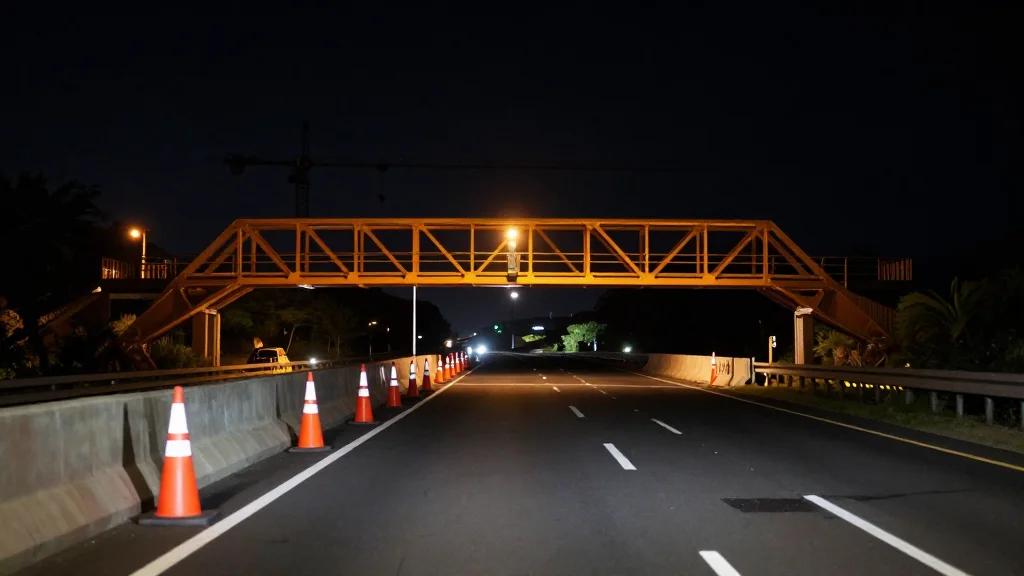
H‑1 Freeway in Hawaii to Close Overnight Saturday for Widening Work, Triggering Major Detours

Why It Matters
The H‑1 freeway is Oahu’s transportation backbone, linking Honolulu’s urban core with suburban communities and the airport. Disruptions to this corridor affect not only daily commuters but also tourism, freight movement, and emergency services. By widening the freeway and replacing the Gulick Avenue overpass, HDOT aims to alleviate chronic congestion, reduce travel times, and improve safety, which are essential for sustaining the island’s economic growth and quality of life. Moreover, the project underscores the challenges of upgrading aging infrastructure in a densely populated, geographically constrained environment. Night‑time closures, while minimizing daytime impact, still strain alternate routes and highlight the need for comprehensive traffic management strategies. The success of this phase will set a precedent for future infrastructure upgrades across Hawaii and similar island jurisdictions.
Key Takeaways
- •Full closure of H‑1 between Middle Street merge and Likelike Highway off‑ramp from 8 p.m. Saturday to 8 a.m. Sunday
- •Three lanes between Kaamilo Overpass and H‑1/H‑2 merge closed alternately from 7 p.m. Saturday to 8 a.m. Sunday
- •Four on‑ramps (King Street, Airport Viaduct, Likelike Highway, Middle Street) shut during the overnight window
- •Detour routes: North King Street, Dillingham Boulevard, North School Street for eastbound; Likelike Highway off‑ramp and Dillingham Boulevard for westbound
- •Project part of $1.2 billion H‑1 widening; next full closure slated for July 11‑12 for temporary bridge installation
Pulse Analysis
The overnight shutdown of the H‑1 freeway illustrates the tightrope that transportation agencies walk when modernizing legacy corridors in high‑demand environments. On Oahu, where land is scarce and the freeway serves as the primary conduit for both residents and tourists, any reduction in capacity quickly translates into gridlock on surface streets. HDOT’s decision to concentrate the most disruptive work—full closure and lane alternations—into a single 13‑hour window reflects a strategic trade‑off: accept a short, intense surge in congestion to preserve the bulk of weekday traffic flow.
Historically, Hawaii’s infrastructure projects have been hampered by funding constraints and the logistical complexities of island construction. The $1.2 billion H‑1 widening, financed through a mix of state bonds and federal grants, is one of the most ambitious undertakings in the state’s recent history. By prioritizing the temporary pedestrian bridge and the Gulick Avenue overpass demolition, HDOT is addressing a choke point that has limited the freeway’s throughput for decades. Once completed, the added lanes and upgraded interchanges are projected to shave up to five minutes off peak‑hour trips, a modest gain that nonetheless represents a significant quality‑of‑life improvement for commuters.
Looking forward, the success of this phase will hinge on effective communication and real‑time traffic management. The agency’s use of a dedicated website (h1widening.com) and coordination with navigation providers can mitigate driver frustration and distribute traffic more evenly across alternate routes. If the July 11‑12 closure proceeds without major incident, it will reinforce confidence in HDOT’s ability to deliver large‑scale projects on schedule—a critical factor as the state contemplates further expansions, including potential public‑transit integrations and resilience upgrades to address climate‑related risks. In sum, the overnight closure is a microcosm of the broader challenges and opportunities facing island transportation networks in the 21st century.
H‑1 Freeway in Hawaii to Close Overnight Saturday for Widening Work, Triggering Major Detours
Comments
Want to join the conversation?
Loading comments...