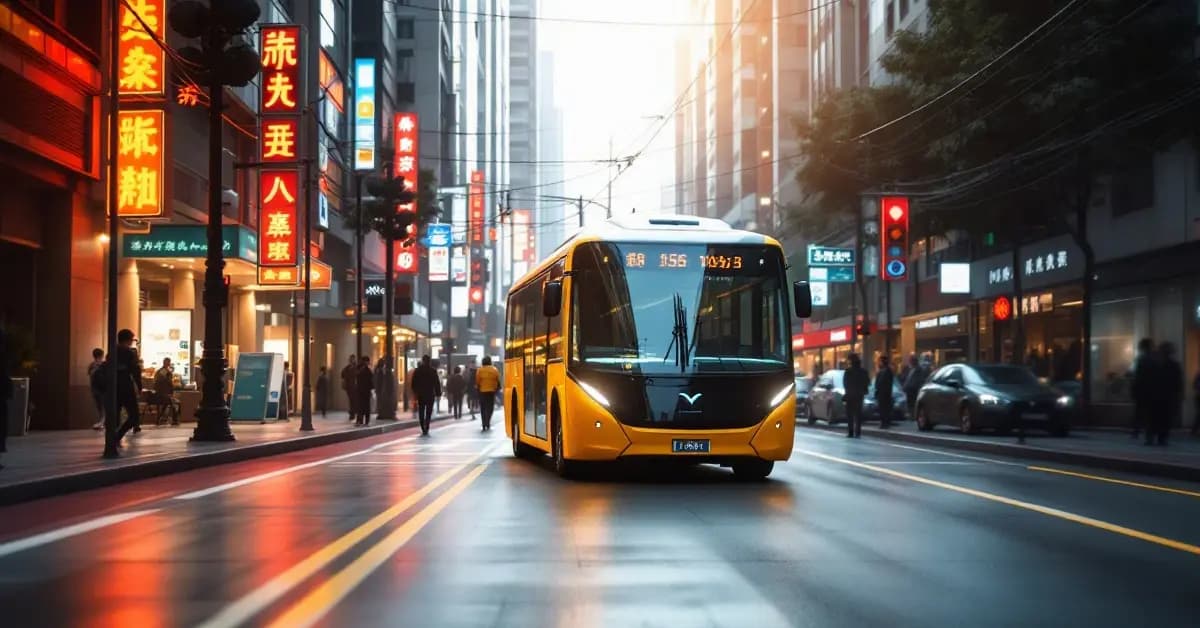
Hong Kong Approves Autonomous Bus Trial Between Sunny Bay and Siu Ho Wan
Why It Matters
The trial provides critical real‑world data for autonomous mobility in Hong Kong’s dense, tunnel‑heavy environment, accelerating policy development and commercial readiness for AVs in the region.
Key Takeaways
- •Hong Kong granted pilot licence for 20‑seat autonomous bus trial
- •Trial route runs Sunny Bay to Siu Ho Wan via Discovery Tunnel
- •Neuromorphic event‑based cameras tested to speed reaction times
- •Smart Traffic Fund finances the autonomous bus development
- •Data will shape Hong Kong’s AV regulatory framework and rollout
Pulse Analysis
Hong Kong’s autonomous‑bus pilot arrives at a time when cities worldwide are racing to validate driverless technology in complex urban settings. While many jurisdictions focus on straight‑away corridors, Hong Kong’s dense network of tunnels, steep gradients, and mixed traffic presents a uniquely demanding testbed. By granting a licence under the Road Traffic (Autonomous Vehicles) Regulation, the government signals confidence that its infrastructure can accommodate high‑precision perception systems, positioning the city as a potential showcase for Asian AV deployment.
The trial’s technical centerpiece is a neuromorphic event‑based camera, a sensor that mimics human retinal processing to capture changes in light rather than static frames. This approach promises millisecond‑level reaction times, a crucial advantage when navigating narrow lanes and sudden pedestrian movements common in Hong Kong’s public transport interchanges. Backed by the Smart Traffic Fund, the project also illustrates how targeted public‑sector financing can de‑risk innovative hardware, encouraging manufacturers to tailor solutions for markets with intricate road geometries. Industry partners gain a live laboratory, while the government gathers granular performance data to refine safety standards.
Beyond the hardware, the pilot serves as a policy incubator. Data collected will feed the Autonomous Vehicle Applications Promotion Working Group, informing updates to the Code of Practice and shaping licensing criteria for future commercial services. Successful outcomes could unlock limited‑area, revenue‑generating routes, easing congestion on popular ferry‑to‑airport corridors. For investors and mobility providers, Hong Kong’s methodical, data‑driven approach offers a replicable blueprint for scaling autonomous transit in other high‑density, tunnel‑rich cities.
Hong Kong Approves Autonomous Bus Trial Between Sunny Bay and Siu Ho Wan
Comments
Want to join the conversation?
Loading comments...