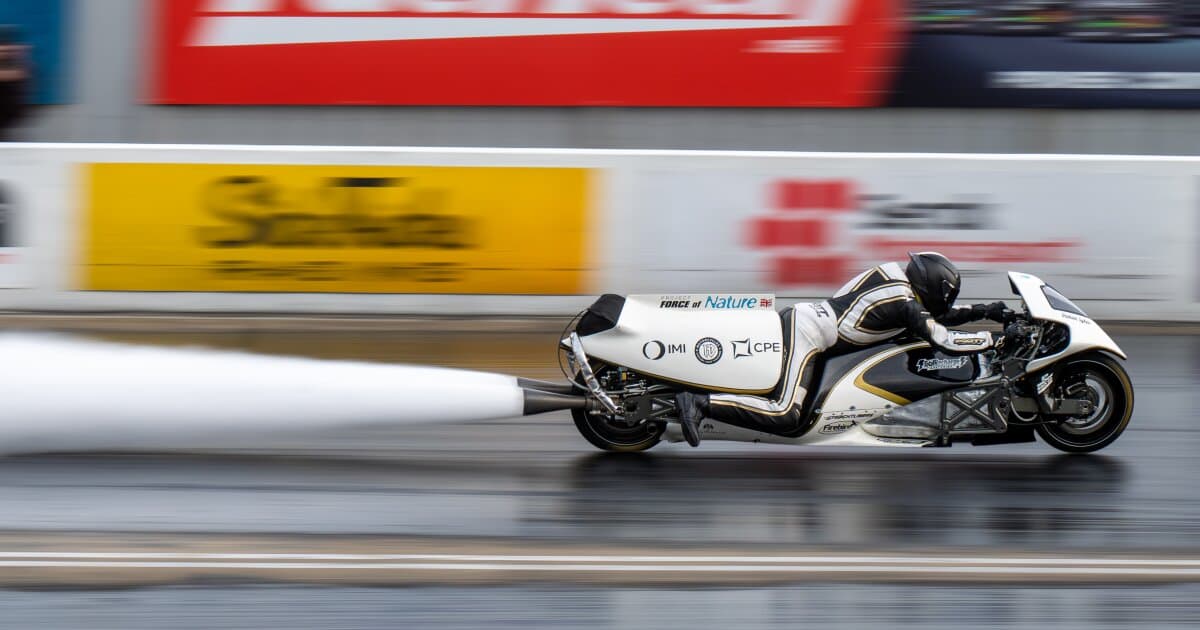
How a Steam-Powered Moto Became the Second-Fastest Bike in the World
Why It Matters
The achievement showcases steam propulsion’s extreme performance potential, challenging conventional internal‑combustion and electric powertrains in motorsports. It also provides engineering insights that could inform future high‑power, low‑emission applications beyond niche racing.
Key Takeaways
- •Force of Nature ran quarter‑mile in 5.503 seconds, 192.94 mph
- •Steam system flashes 120 L water, expanding 1,620:1 ratio
- •Upgrades added carbon bodywork, nitrogen valves, 44 kW burner
- •Launch generates ~6 g acceleration, 40 L water per second
- •Team targets sub‑5‑second quarter‑mile and two‑second 1/8‑mile
Pulse Analysis
The Force of Nature project revives a technology that predates the internal‑combustion engine: steam propulsion. While steam locomotives have long been relegated to museums, Graham Sykes’ workshop in Bedale has engineered a motorcycle that converts 120 liters of super‑heated water into thrust within a fraction of a second. By flashing the liquid to steam at roughly 1.1 times the speed of sound, the bike produces a rapid expansion ratio of 1,620 : 1, delivering a burst of power comparable to a small rocket. This achievement places steam back on the performance map, albeit in a highly specialized arena.
The latest run at the Festival of Power in Santa Pod recorded a quarter‑mile time of 5.503 seconds and a top speed of 192.94 mph, eclipsing all but Eric Teboul’s rocket‑powered machine. Recent upgrades—carbon‑fiber bodywork, nitrogen‑actuated valves, and a 44 kW burner—have trimmed heat‑up cycles and sustained pressures of 40–50 bar, enabling launches that generate around 6 g of acceleration and eject 40 L of water per second. Compared with traditional sport bikes, the steam bike’s thrust‑to‑weight ratio is extraordinary, but its all‑or‑nothing valve operation limits practical road use.
Although a production version remains unlikely, the engineering lessons from Force of Nature could influence high‑energy sectors such as launch‑assist vehicles, emergency power units, or hybrid propulsion concepts seeking rapid energy release without combustion pollutants. The project's iterative development cycle—now in its fifth stage—demonstrates how small teams can push the boundaries of thermodynamic conversion efficiency. As the team eyes a sub‑5‑second quarter‑mile and a two‑second 1/8‑mile, the motorcycle serves as a live laboratory, reminding the industry that unconventional power sources still have untapped performance potential.
How a steam-powered moto became the second-fastest bike in the world
Comments
Want to join the conversation?
Loading comments...