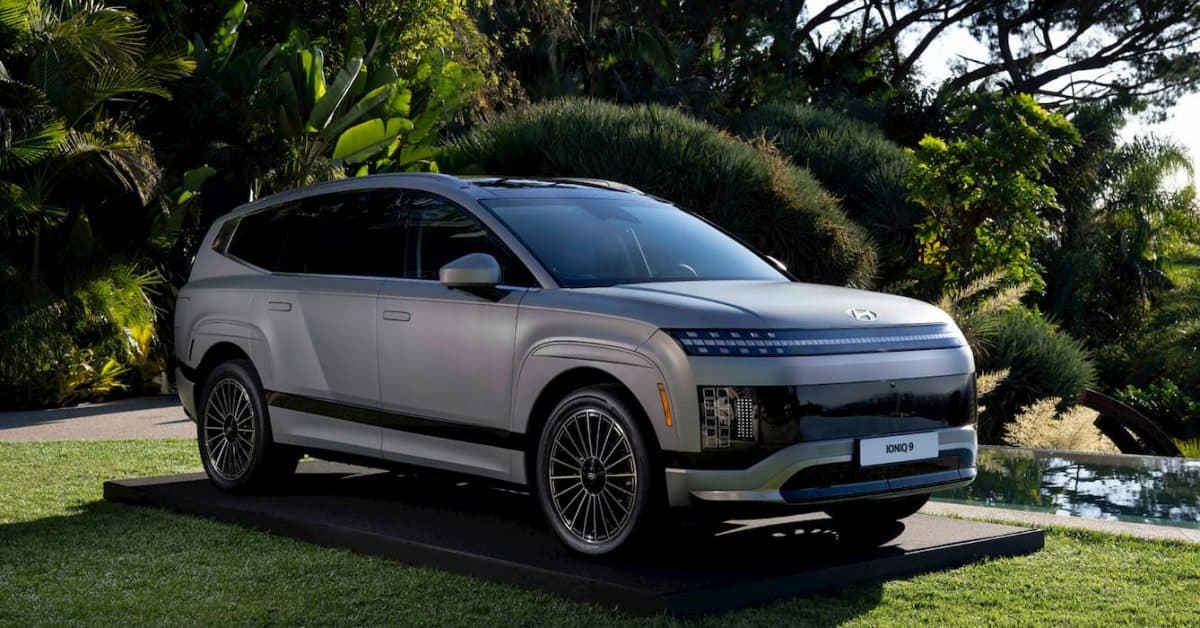
Hyundai Celebrates IONIQ 9 Success in Korea with More EV Discounts
•March 2, 2026
0
Why It Matters
The strong sales and award win validate Hyundai’s EV strategy, pressuring rivals in the competitive three‑row electric SUV market and accelerating consumer adoption through aggressive pricing incentives.
Key Takeaways
- •IONIQ 9 sold 8,227 units in Korea 2025.
- •Sales five times Kia EV9, leading three‑row EV segment.
- •Hyundai offers 1 million won discount on all EV models March.
- •Online event gives coupons up to 10.4 million won.
- •US promotion includes up to $10,000 off and 0% APR.
Pulse Analysis
The Hyundai IONIQ 9’s sweep of the 2026 Car of the Year awards marks a watershed moment for the South Korean automaker’s electric‑vehicle ambitions. Launched in early 2025, the three‑row SUV combines a 532‑kilometre WLTP range, fast‑charging capability and a spacious interior that appeals to families and tech‑savvy buyers. According to the Korea Automobile Mobility Industry Association, 8,227 units were delivered in 2025, a figure that dwarfs the 1,549 EV9s sold by Kia and outpaces other Hyundai EVs such as the EV4 and EV5. The accolade reinforces the IONIQ 9’s reputation for performance and practicality, positioning it as a benchmark in the burgeoning three‑row EV segment.
Hyundai is leveraging the award momentum with a series of price‑reduction programmes aimed at lowering the total cost of ownership. A flat 1 million won (about $650) discount applies to the IONIQ 5, IONIQ 6, IONIQ 9 and Kona Electric for purchases made in March, while an online event offers discount coupons up to 10.4 million won. These incentives complement the U.S. Getaway Sales Event, which provides up to $10,000 off and 0 % APR financing for 72 months. By compressing the price gap with rivals such as Tesla and BYD, Hyundai hopes to accelerate fleet turnover and capture price‑sensitive consumers.
The aggressive discounting underscores a broader industry trend: manufacturers are using short‑term rebates to boost volume as battery costs continue to decline. Hyundai’s strategy not only strengthens its foothold in its home market but also signals confidence in scaling the IONIQ 9 globally, where competition from the Tesla Model Y and upcoming Chinese three‑row EVs is intensifying. If the Korean sales surge translates into sustained demand, Hyundai could justify further investment in EV platforms, solidify its position as a leading electrifier, and influence regulatory incentives aimed at expanding zero‑emission vehicle adoption.
Hyundai celebrates IONIQ 9 success in Korea with more EV discounts
0
Comments
Want to join the conversation?
Loading comments...