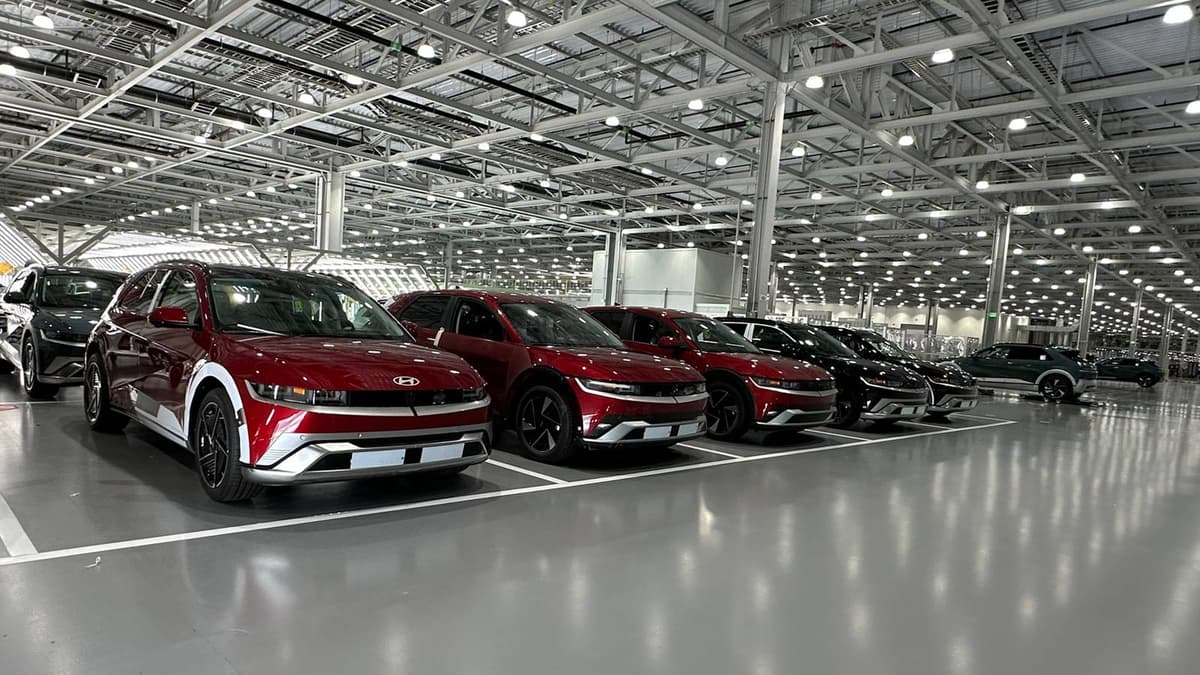
I Visited Hyundai's $12.6 Billion Metaplant and Now I Understand Why Tesla Should Be Worried
Companies Mentioned

Why It Matters
Hyundai’s massive U.S. investment accelerates domestic EV supply, threatening Tesla’s market share and prompting industry‑wide shifts toward sustainable manufacturing. The plant’s scale and technology set a new benchmark for American auto production.
Key Takeaways
- •Hyundai invested $12.6 B in a 3,000‑acre Georgia smart plant.
- •Plant targets up to 500,000 EVs annually, 80% US sales.
- •Uses 21 hydrogen‑fuel‑cell XCIENT trucks for zero‑emission logistics.
- •Robots like Boston Dynamics’ Spot scan and transport parts on line.
- •Hyundai plans 14 models, including Kia and Genesis, to rival Tesla.
Pulse Analysis
Hyundai’s Metaplant America represents one of the largest single‑investment projects in the U.S. automotive sector this decade. Spanning roughly 3,000 acres near Savannah, the facility integrates advanced manufacturing cells, AI‑driven quality inspection, and a hospitality‑level visitor experience. By embedding renewable energy sources and a dedicated hydrogen refueling hub, Hyundai signals a strategic pivot toward carbon‑neutral production, aligning with both corporate ESG goals and emerging regulatory expectations.
Operationally, the plant showcases a logistics ecosystem powered by 21 XCIENT hydrogen fuel‑cell trucks, eliminating tailpipe emissions for parts transport across the supply chain. Inside, Boston Dynamics’ Spot robot dog conducts real‑time scans of each vehicle, while a fleet of collaborative robots orchestrates assembly and material handling with near‑human precision. The current output of the IONIQ 5 and IONIQ 9 is set to scale dramatically, with capacity plans to reach 500,000 units per year and a model portfolio expanding to include Kia and Genesis offerings, all built on Hyundai’s emerging extended‑range EV architecture.
The broader market impact is profound. Hyundai’s commitment to produce 80% of its U.S. sales domestically narrows the logistical gap that has traditionally favored Tesla’s vertically integrated model. As the plant reaches full capacity, competitors will feel pressure to match Hyundai’s blend of scale, sustainability, and automation. Analysts anticipate that this could compress Tesla’s pricing power, spur faster adoption of hydrogen‑based logistics, and accelerate the overall shift toward high‑volume, low‑cost electric vehicle production in North America.
I visited Hyundai's $12.6 Billion Metaplant and now I understand why Tesla should be worried
Comments
Want to join the conversation?
Loading comments...