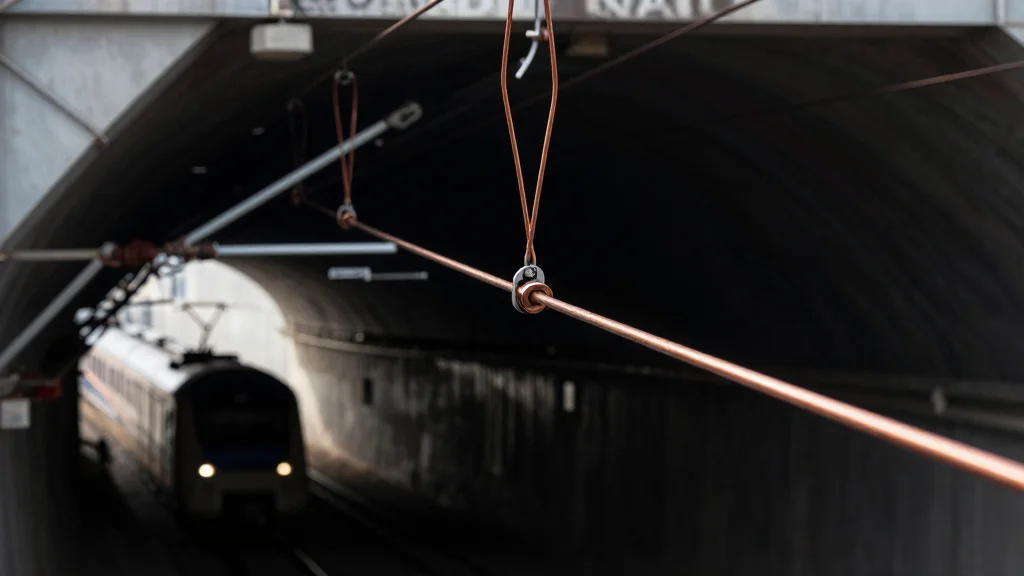
In Pictures: Engineers Complete £23M Severn Tunnel Upgrade
Companies Mentioned
Why It Matters
The upgrade reduces maintenance downtime on a critical cross‑border rail corridor, supporting freight flows and passenger growth. It also showcases a world‑first corrosion‑resistant overhead line solution that could be replicated elsewhere.
Key Takeaways
- •£23 M (≈ $29 M) Severn Tunnel upgrade completed
- •250 engineers worked 24/7 for 16 days
- •838 support arms and 14 km wiring replaced
- •New copper contact wire resists salt‑water corrosion
- •Improves reliability for South Wales‑England passenger and freight services
Pulse Analysis
The Severn Tunnel, a 7‑km conduit linking South Wales with England, has long been a bottleneck for the Great Western rail corridor. Network Rail’s recent £23 million (about $29 million) overhaul tackled the tunnel’s notorious salt‑water environment, which accelerates bi‑metallic corrosion of overhead line equipment. Over a 16‑day shutdown, a 250‑strong crew replaced 838 support arms, laid 14 km of new wiring and installed a continuous copper contact wire supported by modified bridge arms. The bespoke corrosion‑resistant system is expected to cut future maintenance cycles dramatically.
The upgrade’s timing coincided with ancillary works across the Bristol corridor, where engineers renewed more than 1.5 km of track and overhauled drainage between Patchway and Pilning. By addressing both the tunnel’s internal wear and external infrastructure constraints, Network Rail is bolstering capacity for growing passenger demand and preserving a vital freight artery that moves goods between the UK’s industrial heartlands. Improved reliability reduces delay‑related costs for operators and enhances the competitiveness of rail versus road haulage, aligning with the government’s decarbonisation targets.
Beyond the immediate benefits, the Severn Tunnel project represents a world‑first deployment of a copper‑based overhead line system engineered for high‑salinity conditions. This innovation could set a new benchmark for other coastal or tunnel routes worldwide that grapple with similar corrosion challenges. The collaboration between Network Rail, ARQ and specialist suppliers demonstrates how targeted R&D and rapid prototyping can deliver large‑scale infrastructure upgrades without prolonged service interruptions. As rail networks seek to modernise, the Severn Tunnel model offers a replicable template for extending asset life while supporting sustainable transport goals.
In pictures: engineers complete £23M Severn Tunnel upgrade
Comments
Want to join the conversation?
Loading comments...