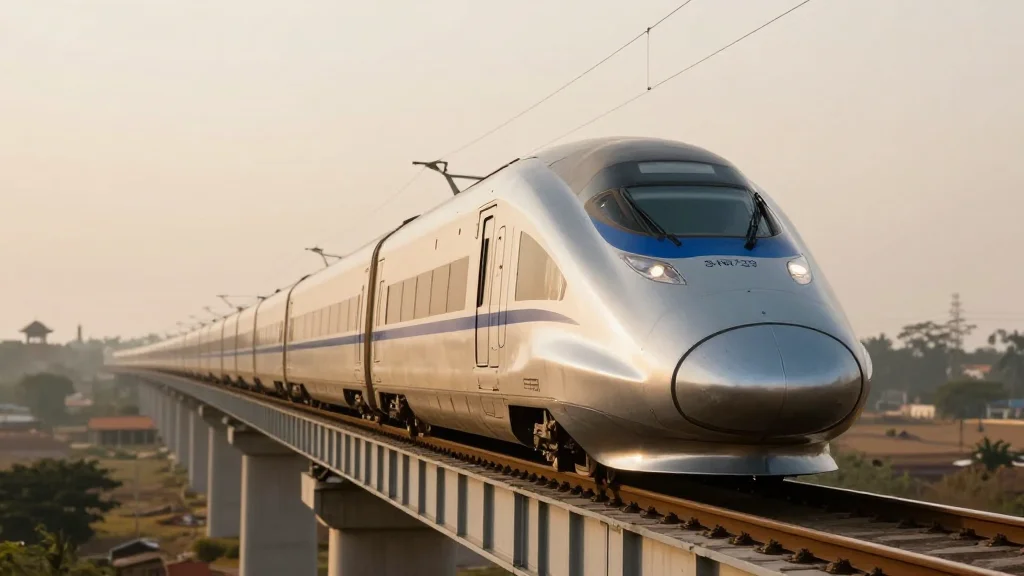
Indian Government Reiterates Commitment to High-Speed Rail
Why It Matters
The initiative signals long‑term infrastructure ambition despite fiscal pressures, promising to boost regional connectivity, freight efficiency and economic growth across India.
Key Takeaways
- •Delhi‑Agra HSR segment costs $24.2 bn, $2.65 bn per km
- •Government eyeing PPPs, loans, land‑value capture for financing
- •First priority corridors: Delhi‑Agra and Surat‑Nagpur freight line
- •Seven HSR routes total ~4,000 km, require ~$195 bn investment
- •Land identification underway; integrated townships planned near stations
Pulse Analysis
India’s renewed push for high‑speed rail reflects a strategic pivot toward modernizing its transport backbone. By combining traditional government equity with innovative financing—public‑private partnerships, multilateral loans, and land‑value capture—the country aims to marshal the roughly $195 billion needed for seven corridors. This financial mosaic not only spreads risk but also aligns with broader policy goals of attracting private capital to capital‑intensive projects, even as the nation grapples with energy‑price volatility stemming from Middle‑East tensions.
The rollout will be incremental, targeting the most revenue‑rich segments first. The Delhi‑Agra stretch, part of the larger Delhi‑Varanasi line, has been earmarked as the flagship, with updated detailed project reports refining alignments and cost estimates. Simultaneously, the Surat‑Nagpur segment of the 2,100‑km Dankuni‑Surat Dedicated Freight Corridor is moving forward, promising to enhance freight capacity and support double‑stack container operations. Station sites near Mathura, Itauli and Agra are already under land‑identification processes, with plans for integrated townships that could spur local development.
Linking high‑speed passenger services with a robust freight corridor creates a synergistic logistics ecosystem. Faster passenger travel will shrink travel times between major economic hubs, while the dedicated freight line will streamline cargo movement, reducing bottlenecks on congested conventional tracks. Together, these projects are poised to catalyze regional trade, attract foreign investment, and generate employment, positioning India’s rail network as a cornerstone of its long‑term growth agenda. However, successful execution will hinge on disciplined project management, transparent procurement, and sustained political will.
Indian government reiterates commitment to high-speed rail
Comments
Want to join the conversation?
Loading comments...