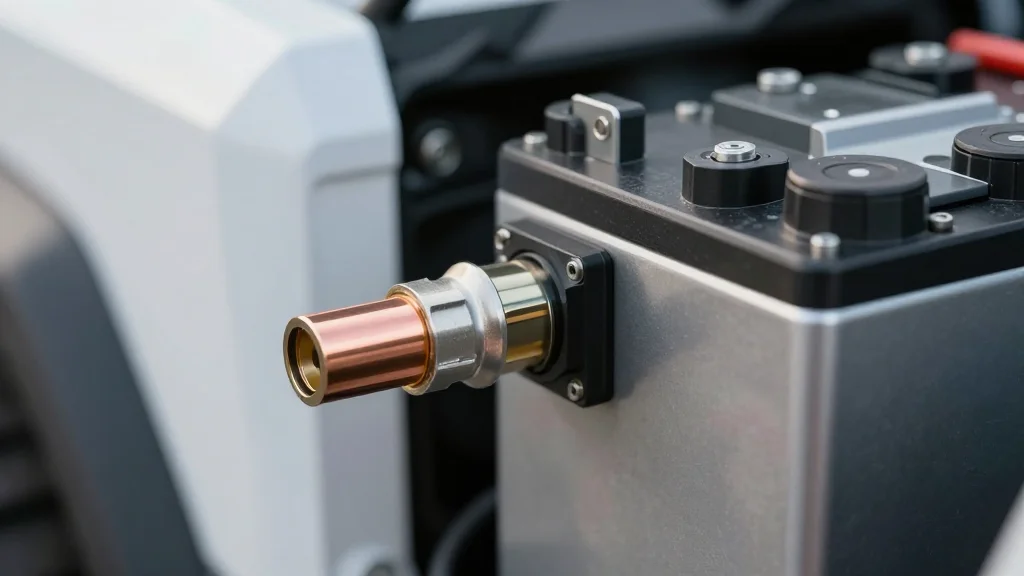
Kinell’s New Coupling System Manages Pre-Charge and Hot-Plug Disconnection for HVDC Vehicle Systems
Companies Mentioned
Why It Matters
By eliminating bespoke integration work, Kinell’s system cuts development time and downtime, accelerating modular electric power‑train adoption in heavy‑duty off‑road markets.
Key Takeaways
- •Kinell's unit isolates coupling functions in a standalone subsystem.
- •Enables hot‑plug battery swapping on electric trucks without HV shutdown.
- •Includes built‑in DC/DC converter for differing voltage levels.
- •Performs pre‑charge, isolation checks, and real‑time fault monitoring.
- •Reduces vehicle redesign costs for adding external HV sources.
Pulse Analysis
The off‑highway sector has long wrestled with the rigidity of closed‑loop high‑voltage architectures, where any addition of a range extender or auxiliary load demands a custom redesign of both vehicle and external hardware. Kinell’s HVDC coupling system tackles this bottleneck by packaging all connection logic into a single, plug‑and‑play module. This approach mirrors the broader industry shift toward modularity—similar to how data‑center power distribution moved from monolithic designs to hot‑swappable units—allowing OEMs to offer interchangeable power sources without compromising safety or performance.
Technically, the coupling unit integrates a high‑voltage interface box, sensor suite, actuator mechanisms, and a DC‑DC converter capable of bridging disparate voltage levels. Before contact is made, the system conducts isolation resistance measurements and verifies connector presence, then executes a controlled pre‑charge to balance voltages and limit inrush currents. During operation it continuously monitors current, temperature and fault conditions, and can execute a controlled disconnect if an overload or accidental unplug occurs. The use of the AEF/ISO 23316‑2 high‑power interface standard ensures compatibility with a range of battery formats, while the pull‑off and interlock pins provide mechanical assurance against accidental disengagement.
For fleet operators in agriculture, construction and mining, the ability to swap batteries on the move translates directly into higher equipment uptime and lower logistical overhead. OEMs can now design a base vehicle platform and offer a menu of battery capacities or specialty power packs as optional accessories, opening new revenue streams and simplifying after‑sales support. As electrification accelerates across heavy‑duty sectors, solutions like Kinell’s coupling system are likely to become a de‑facto standard, prompting competitors to develop similar hot‑plug architectures and driving further innovation in modular electric powertrains.
Kinell’s new coupling system manages pre-charge and hot-plug disconnection for HVDC vehicle systems
Comments
Want to join the conversation?
Loading comments...