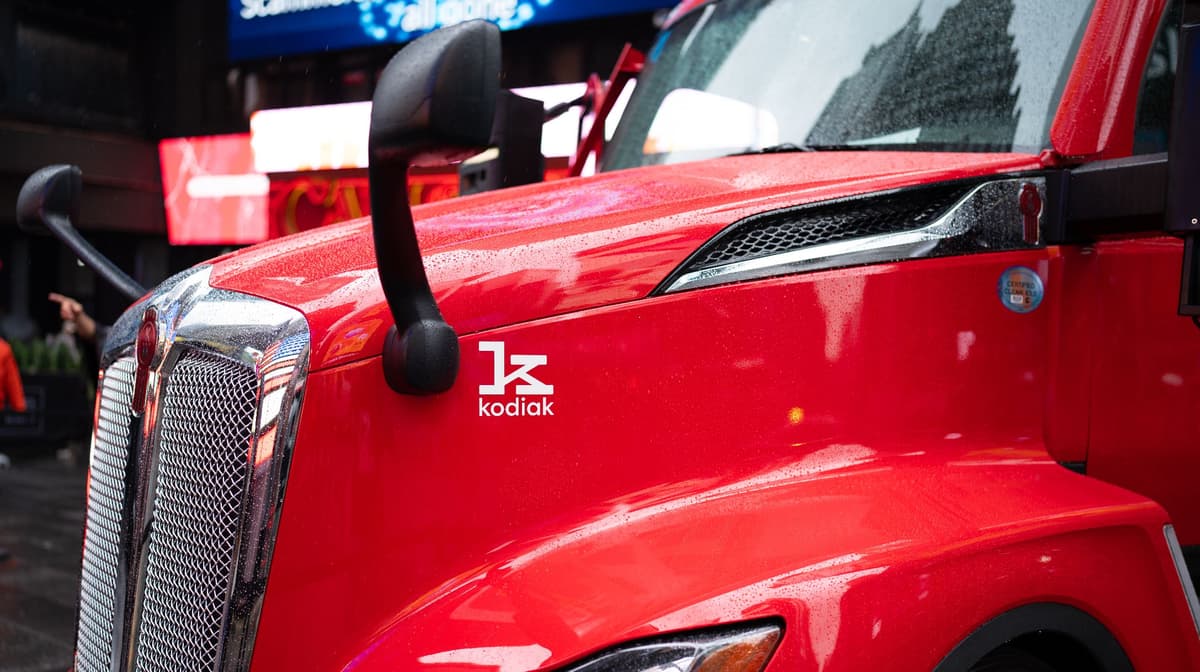
Kodiak Advances Autonomous Driving Safety Validation with Two New AI Tools
Companies Mentioned
Why It Matters
By delivering quantifiable safety metrics, Kodiak can demonstrate superior performance to human drivers, easing regulator and public acceptance while cutting development costs.
Key Takeaways
- •PRA estimates collision rates and severity using Bayesian risk modeling.
- •BreakPoint injects adversarial faults to uncover hidden failure modes.
- •Combined tools prioritize testing of rare, high‑risk scenarios.
- •Safety metrics are benchmarked against human‑driver performance baselines.
- •Approach reduces need for millions of miles of real‑world driving.
Pulse Analysis
The autonomous‑vehicle sector faces a paradox: rapid algorithmic advances outpace the ability to prove safety in a reproducible, regulator‑friendly way. Traditional validation relies on accumulating millions of miles of on‑road data, a costly and time‑consuming approach that still leaves rare edge cases under‑examined. Industry analysts therefore look for methods that can extract statistically meaningful safety signals from limited real‑world exposure while supplementing gaps with high‑fidelity simulation.
Kodiak’s Probabilistic Risk Assessment (PRA) tackles this gap by marrying Bayesian probability theory with systems‑engineering reliability analysis. The framework breaks every driving situation into exposure frequency, collision likelihood, and severity, then produces a bounded estimate of expected collisions across a spectrum of scenarios. By benchmarking these estimates against human‑driver baselines sourced from leading transportation research centers, Kodiak can objectively claim superior safety performance, a critical lever for gaining regulatory approval and public trust.
Complementing PRA, the BreakPoint AI tool adopts an adversarial testing mindset, deliberately injecting time‑varying perception and control faults to provoke failure modes that rarely appear in natural driving. This proactive discovery of hidden hazards feeds directly back into the PRA model, sharpening risk prioritization and focusing simulation resources on the most consequential unknowns. The synergy of statistical risk quantification and AI‑driven edge‑case hunting not only shortens development cycles but also signals a broader industry shift toward evidence‑based safety cases that can replace brute‑force mileage accumulation.
Kodiak advances autonomous driving safety validation with two new AI tools
Comments
Want to join the conversation?
Loading comments...