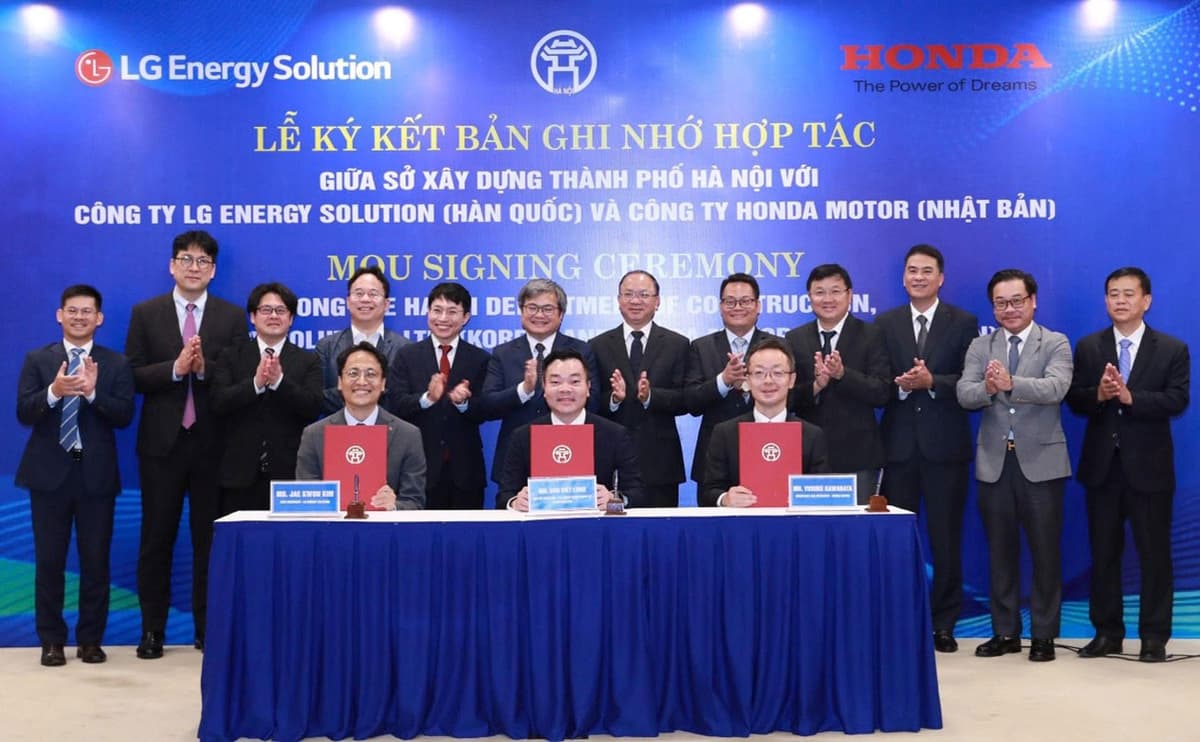
LG Energy Solution and Honda to Deploy Hanoi Battery Swap
Companies Mentioned
Why It Matters
The partnership creates the infrastructure needed for rapid EV two‑wheel adoption in a market dominated by Honda, aligning with Hanoi’s upcoming ICE bans and offering a scalable model for Southeast Asia’s mobility transition.
Key Takeaways
- •Pilot will install ~50 battery‑swap stations across Hanoi
- •LG to supply 2170 cylindrical batteries and manage station safety
- •Honda provides 500 electric two‑wheelers and swap‑compatible units
- •Hanoi plans ICE motorcycle restrictions starting July 2026
- •Vietnam’s 80 million two‑wheelers market offers huge EV growth potential
Pulse Analysis
Vietnam’s two‑wheel market is among the world’s largest, with roughly 80 million motorcycles on the road in 2025. Yet electric two‑wheelers account for only about 4 % of that fleet, leaving a massive untapped demand for clean mobility. The government of Hanoi has responded with a phased ban on internal‑combustion‑engine bikes, slated to begin in July 2026 and extend through 2030. This regulatory timeline creates a clear incentive for rapid infrastructure rollout, positioning battery swapping as a pragmatic bridge between existing riders and fully electric adoption.
The three‑party memorandum of understanding between LG Energy Solution, Honda and the Hanoi municipality outlines a pilot of roughly 50 battery‑swapping stations (BSS) and 500 Honda‑branded electric scooters equipped with LG’s 2170 cylindrical cells. LG will oversee battery lifecycle safety, remote monitoring and station operations, while Honda supplies the vehicles and the modular battery packs that can be exchanged in under three minutes. By leveraging Honda’s 86 % market share, the program aims to demonstrate that a dense BSS network can sustain high‑utilisation fleets without the range anxiety that has hampered EV two‑wheel uptake elsewhere.
If the pilot proves successful, the model could be replicated across Vietnam’s other megacities and eventually the broader Southeast Asian region, where similar congestion and pollution challenges exist. Battery‑swap stations require less real‑estate than fast‑charging depots and can be powered by renewable energy, amplifying their climate benefits. For LG, the project showcases the scalability of its 2170 platform beyond passenger cars, while Honda gains a foothold in the next generation of mobility. Investors and policymakers will watch the rollout closely as a bellwether for the region’s electric two‑wheel transition.
LG Energy Solution and Honda to deploy Hanoi battery swap
Comments
Want to join the conversation?
Loading comments...