Mercedes Set A New Safety Benchmark In 1959, And Now It's Everywhere

Companies Mentioned
Why It Matters
The crumple zone’s ability to dissipate impact forces dramatically reduces fatalities, making it a cornerstone of global automotive safety standards. Its continued adoption drives regulatory compliance and consumer confidence, influencing vehicle design and market competitiveness.
Key Takeaways
- •Mercedes introduced crumple zones on 1959 W111/W112 models.
- •Engineer Béla Barènyi is credited as father of passive safety.
- •Crumple zones remain core safety architecture for virtually all modern cars.
- •IIHS crash tests show cars without crumple zones perform poorly.
- •Tesla Cybertruck’s design lacking crumple zones raises expert safety concerns.
Pulse Analysis
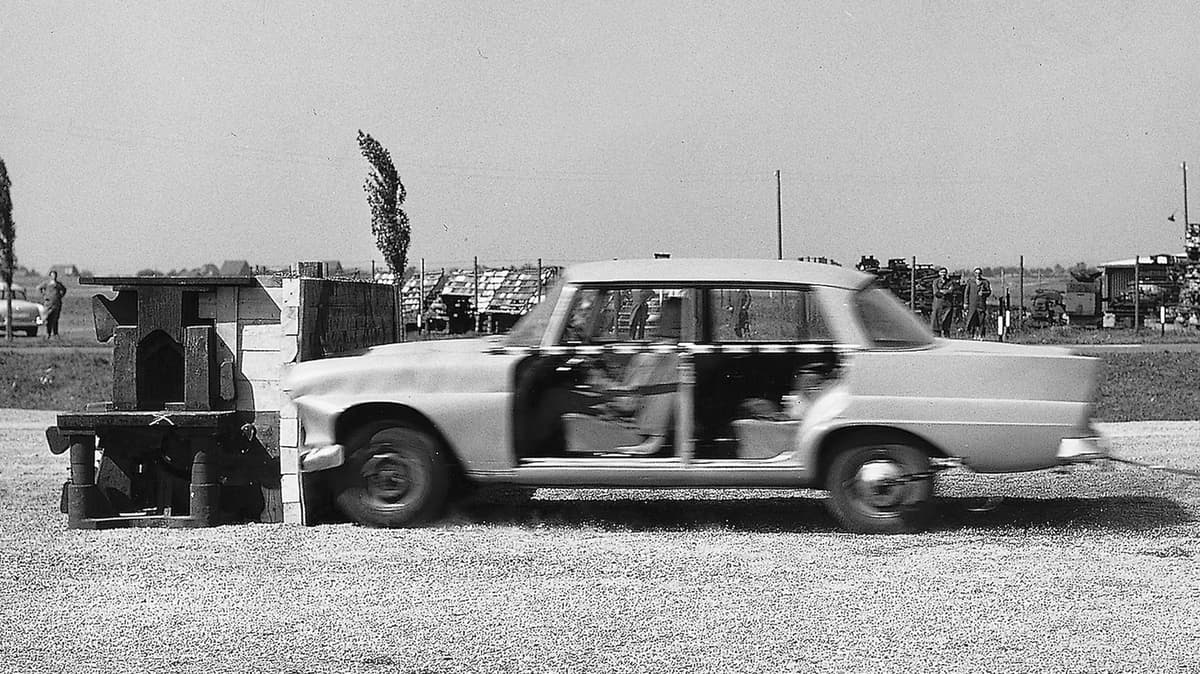
While most drivers associate safety with airbags or electronic stability control, the foundational technology dates back to post‑war Germany. Mercedes‑Benz revived its pre‑war safety program in the late 1940s and hired Béla Barènyi, a Hungarian engineer whose personal experience with injury sparked a lifelong obsession with crash protection. Barènyi’s breakthrough—introducing front and rear deformation zones around a rigid passenger cell—materialized on the 1959 W111 and W112 sedans. The “safety body” concept also bundled innovations such as conical door‑pin locks and systematic crash testing, positioning Mercedes as the era’s safety leader.
At its core, a crumple zone is a sacrificial structure that collapses in a controlled manner, converting kinetic energy into deformation rather than transmitting it to occupants. Early versions relied on thin steel, but modern designs employ high‑strength steel, aluminum alloys, and carbon‑fiber composites to fine‑tune energy absorption while preserving cabin rigidity. Independent agencies like the Insurance Institute for Highway Safety (IIHS) routinely demonstrate the advantage: a 2009 Chevrolet Malibu equipped with contemporary crumple zones outperforms a 1959 Chevrolet Bel Air lacking them in offset‑frontal tests. These results cement the technology’s role in achieving top safety ratings.
The ubiquity of crumple zones has reshaped regulatory frameworks worldwide, with Euro NCAP and U.S. FMVSS mandating specific deformation performance. Automakers that deviate—most notably the Tesla Cybertruck, whose angular exoskeleton omits traditional zones—face heightened scrutiny from safety experts and potential liability exposure. As vehicle architectures evolve toward electric drivetrains and autonomous systems, engineers are integrating adaptive crumple structures that can adjust stiffness in real time. Nonetheless, the basic principle Barènyi introduced remains unchanged: managing crash energy to protect the passenger cell, a timeless pillar of automotive engineering.
Mercedes Set A New Safety Benchmark In 1959, And Now It's Everywhere
Comments
Want to join the conversation?
Loading comments...