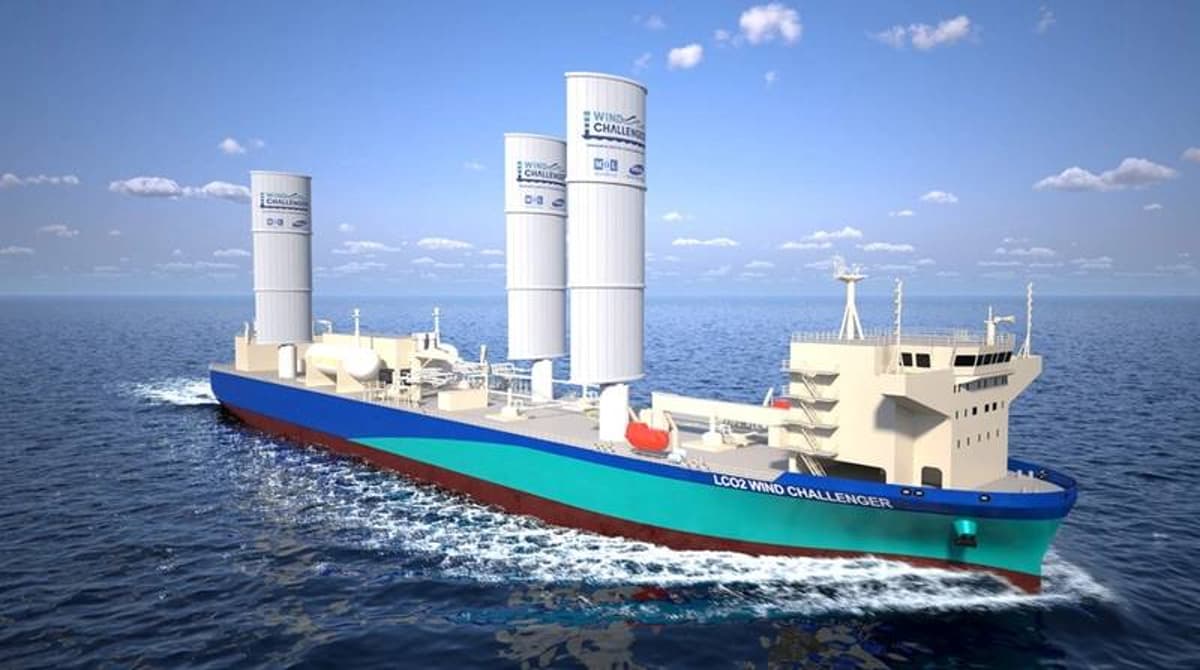
MOL Secures Approval for Wind-Assisted LCO2 Carrier Design
Why It Matters
The approval validates a scalable, low‑carbon shipping solution for the growing CO₂ transport market, helping meet stricter emissions regulations and supporting the CCS industry’s expansion.
Key Takeaways
- •MOL received ClassNK AiP for wind‑assisted LCO₂ carrier design.
- •Vessel capacity ~40,000 m³ for cross‑border liquefied CO₂ transport.
- •Three Wind Challenger rigid sails provide automatic extension, rotation, and retraction.
- •Expected fuel use cut and emissions drop in CCS shipping routes.
- •MOL targets 25 such vessels by 2030, 80 by 2035.
Pulse Analysis
Carbon capture and storage (CCS) is emerging as a cornerstone of global decarbonization strategies, yet the logistics of moving liquefied CO₂ remain energy‑intensive. Traditional tankers rely on diesel engines, contributing a sizable share of emissions within the CCS value chain. By integrating wind‑assisted propulsion, MOL aims to offset a portion of that carbon footprint, positioning the new vessel as a prototype for greener maritime transport and signaling a shift toward hybrid solutions in heavy‑cargo shipping.
The Wind Challenger system, a rigid sail configuration developed with Samsung Heavy Industries, can automatically extend, retract, and rotate to capture optimal wind vectors while preserving navigational safety. ClassNK’s approval in principle confirms that the design meets rigorous classification standards, including reinforced bridge placement and a dedicated passage linking the engine room to crew quarters. These engineering choices not only enhance visibility and crew safety but also enable the sails to operate without compromising vessel stability, a critical factor for carrying volatile, cryogenic CO₂ cargo.
MOL’s roadmap to field 25 wind‑assisted carriers by 2030 and 80 by 2035 reflects a broader industry trend toward decarbonization. If successful, the fleet could reduce fuel consumption by an estimated 10‑15 percent per voyage, translating into millions of dollars in operating cost savings and a measurable drop in maritime CO₂ emissions. The initiative may spur other shipowners to adopt similar technologies, accelerating the transition to sustainable shipping and reinforcing the economic viability of large‑scale CCS projects worldwide.
MOL Secures Approval for Wind-Assisted LCO2 Carrier Design
Comments
Want to join the conversation?
Loading comments...