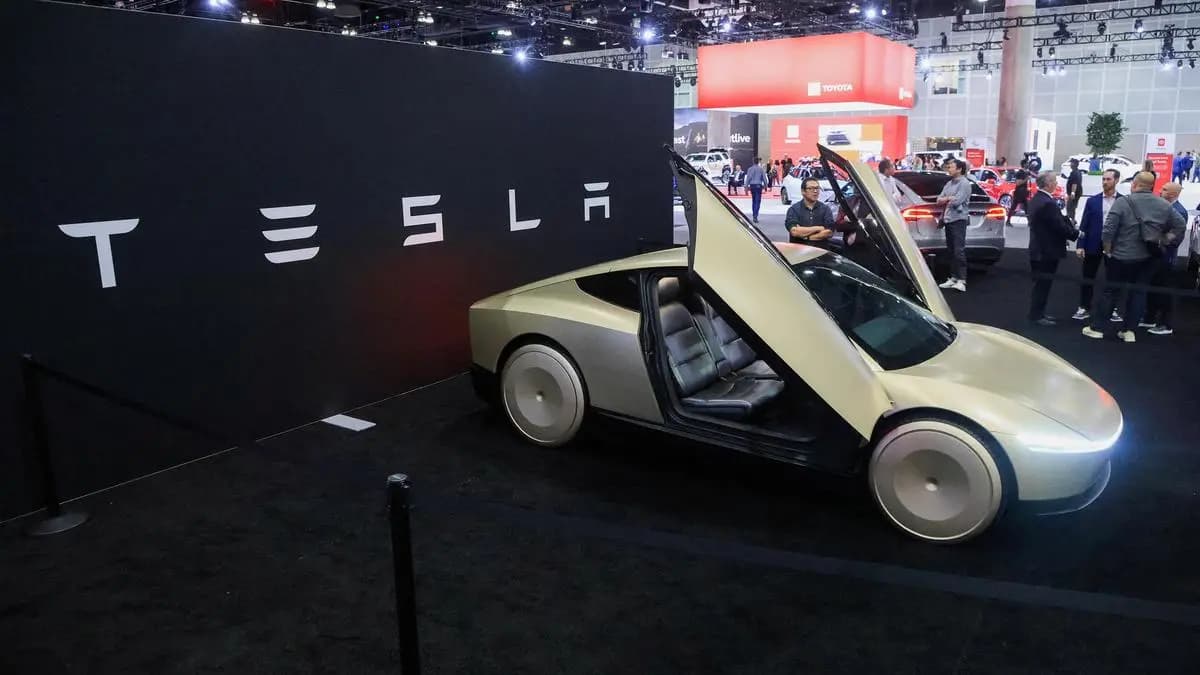
Musk Says Tesla Has Begun Producing Its Cybercab Robotaxi
Companies Mentioned
Why It Matters
The start of Cybercab manufacturing signals Tesla’s transition from pilot projects to a scalable autonomous‑mobility service, potentially unlocking a new, high‑margin revenue stream. It also forces regulators and competitors to confront the practicalities of driverless, steering‑less vehicles.
Key Takeaways
- •Tesla began Cybercab production, its first purpose‑built robotaxi model.
- •Cybercab lacks steering wheel and pedals, requiring U.S. regulatory exemptions.
- •Ride‑hailing rollout targets Phoenix, Miami, Orlando, Tampa, Las Vegas in H1 2026.
- •Tesla expects meaningful robotaxi revenue only after 2027.
- •Shares rose under 1% pre‑market despite 17% YTD decline.
Pulse Analysis
Elon Musk’s announcement that Tesla has moved into serial production of the Cybercab marks a pivotal moment for the company’s autonomous‑vehicle ambitions. The two‑seat, steering‑wheel‑free sedan is the first vehicle designed exclusively for the Robotaxi network, a service Tesla has been piloting in Austin since 2023. By shifting from prototype to manufacturing, Tesla signals confidence that its self‑driving stack is ready for broader deployment, even as overall vehicle sales have slipped this year. The move also puts pressure on rivals such as Waymo and Cruise to accelerate their own mass‑market plans.
Bringing the Cybercab to market, however, hinges on regulatory clearance because the vehicle omits traditional controls. In the United States, the National Highway Traffic Safety Administration must grant a special exemption before a steering‑less car can be sold in volume, a process that could stretch into 2027. Tesla’s approach relies on its “full self‑driving” (FSD) software to monitor the road and intervene when necessary, a claim that regulators have scrutinized after several high‑profile incidents involving beta testers. The outcome of these reviews will shape the speed at which the robotaxi fleet can scale.
Financially, the Cybercab could open a new revenue stream that Musk estimates will become material after 2027, when the robotaxi fleet is expected to reach tens of thousands of units across eight U.S. cities. The pre‑market share uptick of under 1% suggests investors are cautiously optimistic, but the stock remains 17% lower year‑to‑date, reflecting broader demand weakness. If Tesla can achieve economies of scale on the low‑cost Cybercab, it may lower the price barrier for consumers and boost utilization rates, potentially reshaping urban mobility and pressuring legacy automakers to fast‑track their own autonomous offerings.
Musk says Tesla has begun producing its Cybercab Robotaxi
Comments
Want to join the conversation?
Loading comments...