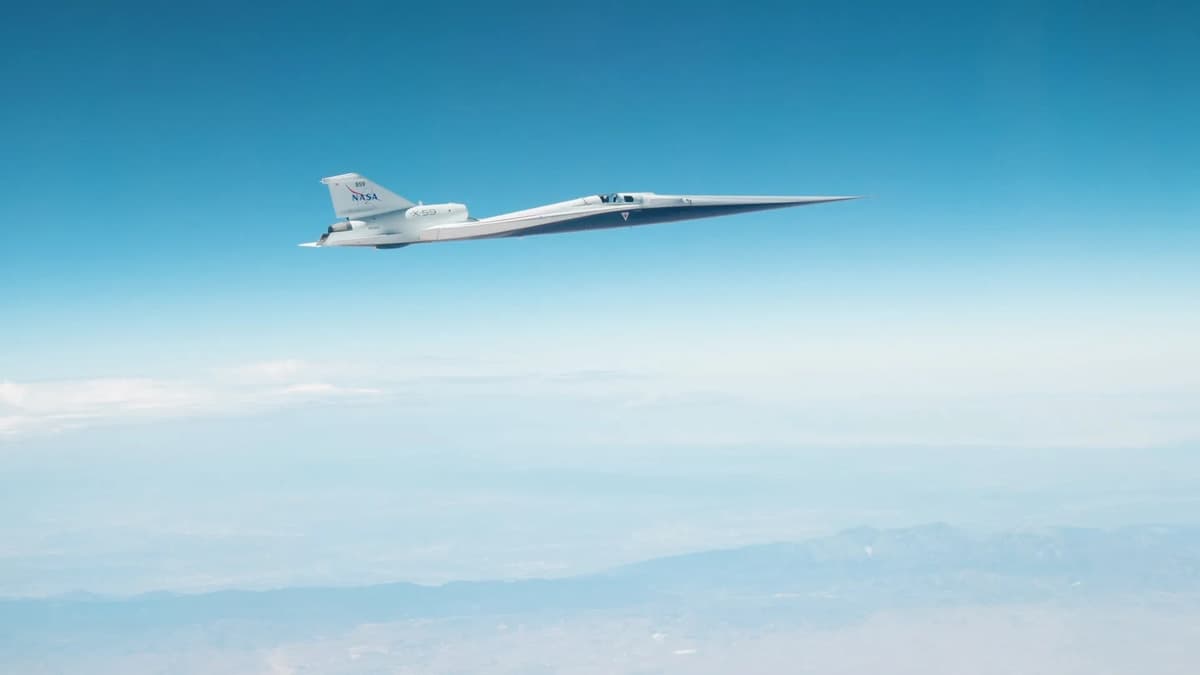
NASA X-59 Hits Planned Supersonic Test Conditions
Companies Mentioned

NASA
Why It Matters
Demonstrating the low‑boom signature at operational speeds validates NASA’s path to quieter supersonic travel, a prerequisite for future commercial routes over populated areas. Successful acoustic testing could reshape regulatory limits on sonic booms and unlock new market opportunities.
Key Takeaways
- •X-59 reached Mach 1.4 and 55,000 ft in one flight.
- •First combined speed‑altitude milestone for NASA’s low‑boom program.
- •F‑15 will carry probe to measure X‑59’s shock wave signature.
- •Acoustic validation will precede community overflight tests later this year.
Pulse Analysis
NASA’s X‑59 QueSST (Quiet SuperSonic Transport) is designed to prove that a supersonic aircraft can fly over land without generating the disruptive sonic boom that has long barred such operations. By shaping the airframe to spread the shock wave, the X‑59 aims to produce a "low‑boom" signature comparable to a distant thunderclap. The recent flight, which hit Mach 1.4 at 55,000 feet, confirms the aircraft can sustain its design envelope, a critical step before moving from pure performance testing to acoustic validation.
The next testing stage pairs the X‑59 with a NASA‑operated F‑15 equipped with a shock‑sensing probe. This instrument will capture the precise pressure signature of the X‑59’s shock wave, providing quantitative data on boom intensity and frequency content. Those measurements will feed into acoustic models that predict how communities experience the noise. Once the probe data validates the low‑boom design, NASA will conduct controlled community overflights, allowing residents to hear the aircraft in real‑world conditions and supply feedback for regulatory review.
If the X‑59’s low‑boom performance meets expectations, it could pave the way for commercial supersonic travel over the United States, a market long constrained by the Federal Aviation Administration’s 75‑decibel over‑flight limit. Airlines and aerospace manufacturers are watching closely, as a relaxed boom standard would open high‑speed routes between major cities, reducing travel times dramatically. The success of NASA’s program therefore has implications far beyond a single test flight, potentially reshaping the future of air travel and prompting new investment in supersonic technology.
NASA X-59 Hits Planned Supersonic Test Conditions
Comments
Want to join the conversation?
Loading comments...