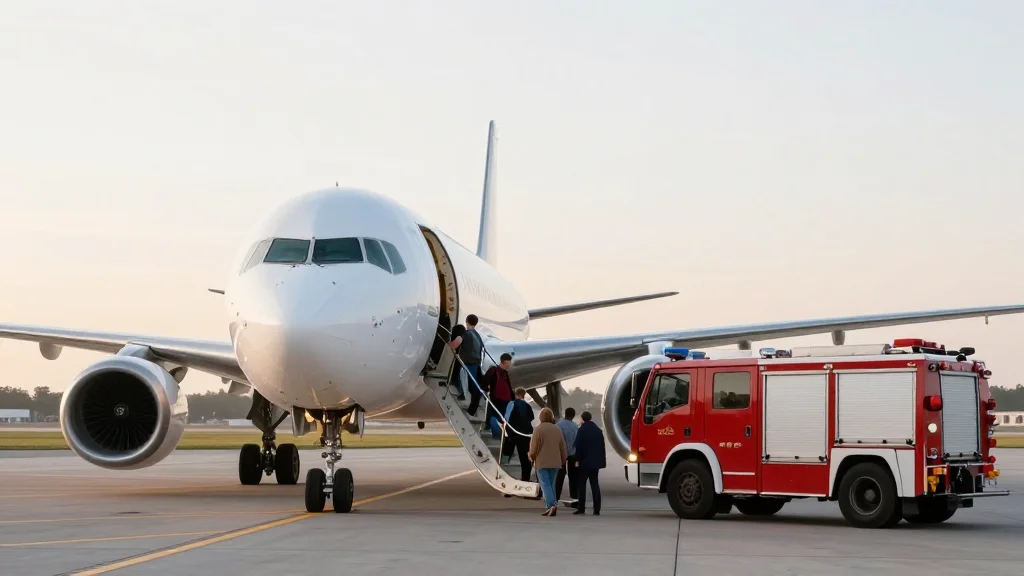
NTSB Investigates Frontier Evacuation After Denver Runway Fatality

Companies Mentioned
Why It Matters
The Denver runway collision spotlights two critical safety domains: perimeter security at sprawling airports and the effectiveness of emergency evacuations when smoke and fire threaten the cabin. A breach of this magnitude raises questions about whether current fencing, sensor arrays, and patrol schedules can reliably deter determined trespassers, especially at facilities covering tens of thousands of acres. Simultaneously, the NTSB’s focus on the evacuation process could lead to stricter rules on slide usage, passenger behavior, and crew decision‑making, potentially reshaping industry standards for handling smoke‑filled cabins. If the board concludes that the evacuation fell short of best‑practice benchmarks, airlines may be required to revise training curricula, limit carry‑on baggage on slides, or adopt new equipment such as rapid‑deployment slide‑covers. On the security side, regulators could push for enhanced perimeter detection technologies, tighter fencing specifications, or increased staffing, all of which would have cost and operational implications for airports nationwide.
Key Takeaways
- •Frontier Flight 4345 struck a pedestrian on Denver runway at 11:19 p.m. Friday
- •All 231 aboard (224 passengers, 7 crew) were evacuated via slides
- •12 passengers suffered minor injuries; 5 were hospitalized
- •NTSB spokesperson Sarah Taylor Sulick said the board is reviewing the evacuation for a possible safety investigation
- •Transportation Secretary Sean Duffy called the breach a "rare but serious vulnerability"
Pulse Analysis
The Denver incident arrives at a moment when the aviation industry is wrestling with two converging pressures: heightened security expectations post‑9/11 and a renewed focus on passenger‑evacuation performance after several high‑profile smoke events. Historically, runway incursions have been dominated by aircraft‑to‑aircraft or vehicle‑to‑aircraft scenarios; a fatal pedestrian strike is an outlier that forces regulators to reconsider the outermost layer of airport defense. While the FAA and TSA have invested heavily in electronic perimeter monitoring, the Denver breach suggests that physical barriers alone may be insufficient when a determined individual bypasses them. Future policy could shift toward integrated sensor‑fence systems that trigger immediate lockdowns of runway access points, a move that would raise capital costs but potentially avert catastrophic loss of life.
On the evacuation front, the NTSB’s scrutiny is likely to echo its 2023 report on United’s Houston evacuation, which highlighted passengers attempting to bring carry‑ons onto slides as a major safety hazard. If the board finds that Frontier’s crew adhered to protocol but passengers’ actions compromised the slide’s efficiency, the agency may issue new guidance limiting baggage on slides or mandating crew‑directed stowage during emergencies. Such recommendations would ripple through airline operating manuals, training simulators, and even aircraft design, as manufacturers might explore slide‑door mechanisms that better control passenger flow.
In the short term, airlines and airports will be under pressure to demonstrate proactive steps—enhanced perimeter patrols at Denver and revised evacuation drills elsewhere—to reassure the traveling public. The NTSB’s final report, expected later this year, could become a catalyst for industry‑wide reforms that tighten both the outer fence and the inner cabin, reinforcing the dual pillars of aviation safety.
NTSB Investigates Frontier Evacuation After Denver Runway Fatality
Comments
Want to join the conversation?
Loading comments...