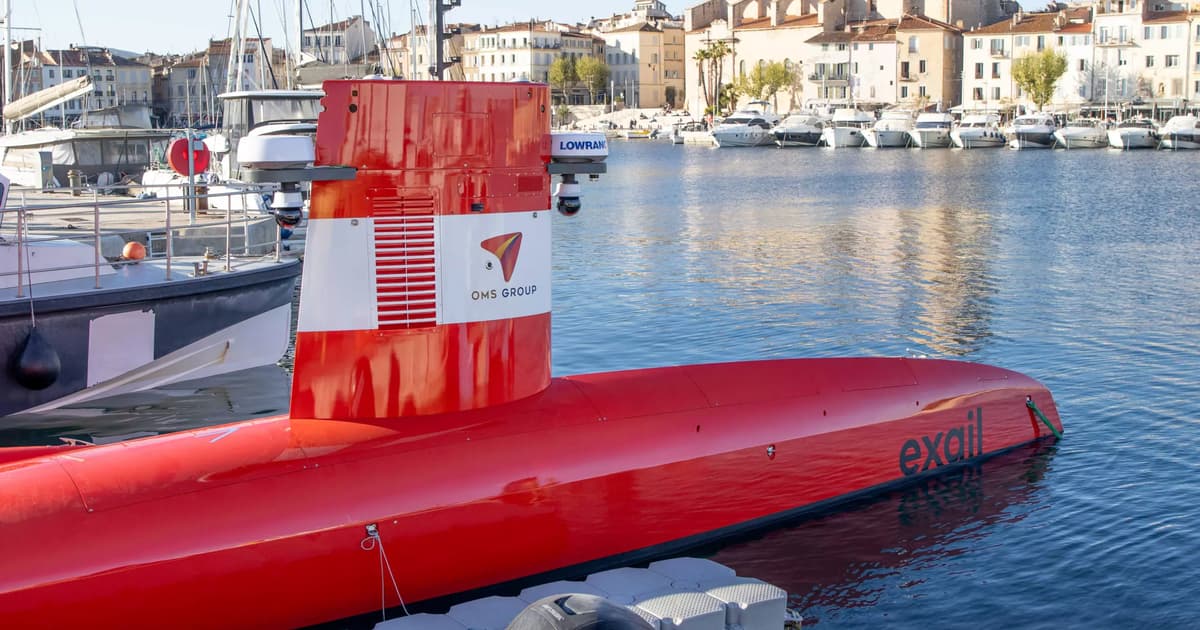
OMS Group Snaps up Second Exail DriX Vessel for Subsea Surveys
Companies Mentioned
Why It Matters
By scaling autonomous survey capacity, OMS can accelerate subsea cable deployments while cutting operational costs and emissions, strengthening its position in a rapidly expanding digital‑infrastructure market.
Key Takeaways
- •OMS adds second Exail DriX O-16 USV to fleet.
- •Vessels enable 30‑day, 3,500‑nm autonomous seabed surveys.
- •Supports $300 million investment in global cable infrastructure.
- •Integrates Kongsberg EM124 multibeam for high‑resolution mapping.
- •Remote Operation Centre in Singapore coordinates multi‑vehicle missions.
Pulse Analysis
The global appetite for subsea fiber optic cables is outpacing traditional survey methods, prompting operators to adopt autonomous platforms that can cover vast oceanic distances without crewed support. Uncrewed surface vessels like the Exail DriX O-16 provide the endurance and precision needed for route verification and environmental monitoring, addressing bottlenecks in project timelines and reducing reliance on costly manned ships. As telecom giants and cloud providers race to lay new trans‑ocean links, the ability to deliver high‑resolution seabed data quickly becomes a competitive differentiator.
OMS Group’s latest acquisition dovetails with its broader $300 million rollout of cable and terrestrial assets across Asia, Europe, and the Americas. By pairing the DriX O-16’s 30‑day endurance with the Kongsberg EM124 multibeam echo sounder, OMS can generate detailed bathymetric maps that meet the stringent tolerances of modern cable laying contracts. The integration of a Remote Operation Centre in Singapore further amplifies operational efficiency, allowing real‑time data validation and coordinated control of multiple autonomous vehicles from a single hub, thereby minimizing on‑site personnel and associated emissions.
Industry analysts view OMS’s expansion of autonomous survey capabilities as a bellwether for the maritime sector’s shift toward greener, data‑driven operations. Competitors are racing to field similar USVs and AUVs, but OMS’s early investment in a cohesive ecosystem—combining surface vessels, underwater drones, and centralized command—positions it to capture a larger share of upcoming subsea infrastructure projects. The move underscores a broader trend: as digital connectivity becomes a cornerstone of economic growth, the tools that enable its physical deployment must evolve toward higher automation, lower carbon footprints, and greater resilience.
OMS Group snaps up second Exail DriX vessel for subsea surveys
Comments
Want to join the conversation?
Loading comments...