Relief May Be on the Way for Shippers
Companies Mentioned
Why It Matters
A potential dip in rates could reduce logistics costs for manufacturers and retailers, while trade‑policy shifts may reshape air‑freight demand patterns this summer.
Key Takeaways
- •May spot rate hit $3.40/kg, +41% YoY, driven by 4% demand growth.
- •Middle East carrier capacity rebounding, expected to ease pricing in June.
- •Shippers extending contracts, paying surcharges, avoiding long‑term commitments.
- •EU ending €150 ($165) de‑minimis exemption adds $3.30 duty per parcel.
- •US proposes 10‑12.5% tariffs on 60 partners, could dampen air freight demand.
Pulse Analysis
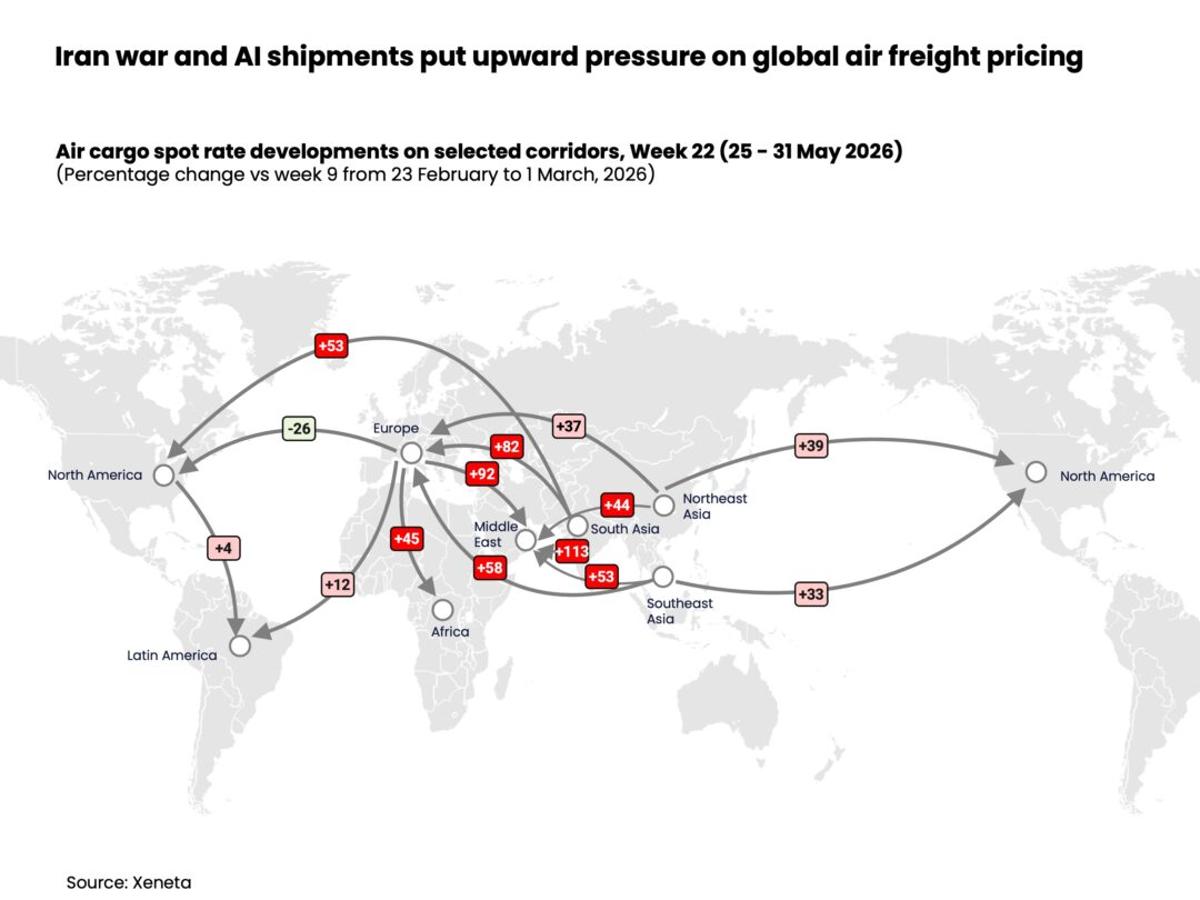
The sharp rise in global air‑cargo spot rates this spring reflects a rare convergence of strong demand and constrained supply. A 4% year‑on‑year increase in cargo volumes pushed the dynamic load factor to 61%, while lingering capacity gaps from the U.S.–Israel–Iran conflict kept available tonne‑kilometers tight. At the same time, AI‑related shipments to data centres and semiconductor fabs have kept trans‑Pacific lanes especially hot, inflating rates on a handful of high‑value corridors despite broader market softness.
Shippers are responding with a cautious, short‑term playbook. Rather than locking in multi‑month contracts, many are extending existing agreements and absorbing surcharges, effectively buying time for rates to normalize. This behavior mirrors front‑loading trends in ocean freight, where producers are shipping now to hedge against anticipated energy cost spikes. If that ocean activity spills over, it could temporarily boost air‑freight demand, but Xeneta’s analysts see the return of near‑full Middle‑East capacity and the traditional summer dip in passenger‑plane belly space as more decisive forces pulling spot rates lower in June.
Regulatory and trade policy developments add a layer of uncertainty that could blunt any rate relief. The EU’s removal of the €150 ($165) de‑minimis exemption, replaced by a $3.30 duty per parcel and a forthcoming $2.20 handling fee, threatens to curb low‑value e‑commerce shipments to Europe. Meanwhile, the U.S. is weighing a 10‑12.5% tariff on goods from 60 partners, including China and the EU, which could suppress cross‑border air freight volumes. Together, these factors suggest a modest, uneven recovery rather than a booming summer for the air‑cargo market.
Relief may be on the way for shippers
Comments
Want to join the conversation?
Loading comments...