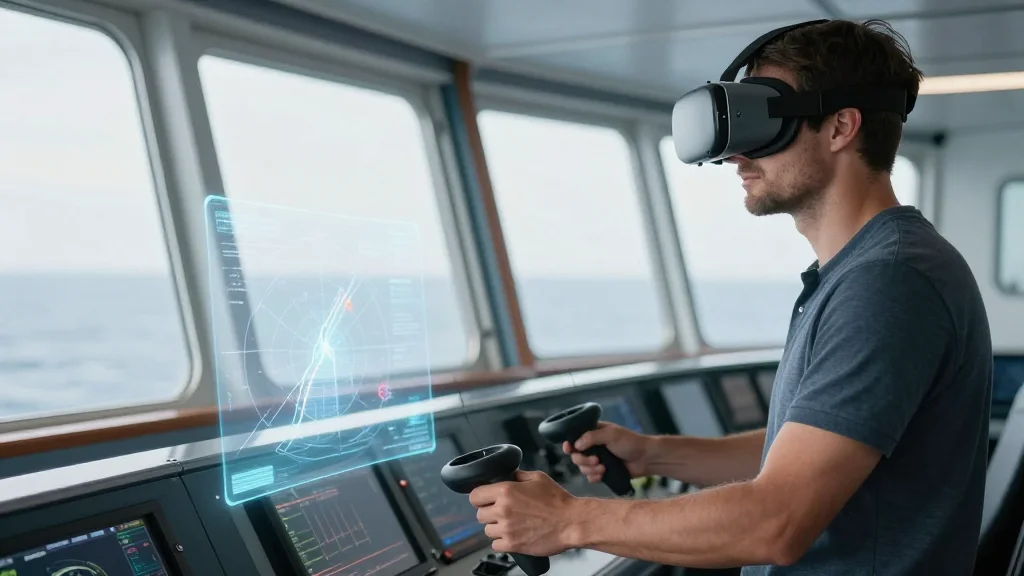
Research Partnership to Quantify Efficacy Maritime Training Immersive Tech
Why It Matters
The initiative provides the maritime sector with a data‑driven, standardized method to prove VR training’s safety and efficiency benefits, accelerating adoption of immersive learning across global fleets.
Key Takeaways
- •Kilo's VASCO VR bridge simulator used for immersive maritime training
- •University of Plymouth leads development of rubric‑based VR assessment framework
- •Project compares cadet and veteran performance in realistic bridge scenarios
- •Open‑source white paper will guide industry adoption of VR training
- •International collaboration strengthens evidence base for safer maritime operations
Pulse Analysis
Immersive technologies such as virtual reality are reshaping professional training across high‑risk sectors, and the maritime industry is no exception. Traditional bridge simulators have long been used to teach navigation, yet they often lack the fidelity needed to capture the cognitive load of real‑world traffic and emergencies. By placing crews in a fully interactive 360‑degree environment, VR can replicate pressure points, decision‑making bottlenecks, and communication dynamics that are difficult to reproduce on static rigs. This shift promises not only faster skill acquisition but also measurable data on human performance.
The nine‑month research venture, led by the University of Plymouth and supported by Odesa National Maritime University and Kilo Solutions, tackles this gap with a structured, rubric‑based assessment framework. Using Kilo’s VASCO VR bridge simulator, the team will run a series of high‑traffic and emergency scenarios, recording decision‑making speed, situational awareness, and team communication. By comparing cadets with seasoned officers, the study will isolate how expertise influences behaviour under stress. The resulting framework, validated through peer‑review, will be released as an open‑source white paper, giving training providers a standardized metric for VR efficacy.
Industry stakeholders stand to gain a clear, data‑driven justification for investing in VR‑based curricula, potentially reducing costly at‑sea incidents and accelerating crew certification. The international nature of the collaboration also signals a growing consensus on the need for unified training standards across jurisdictions, a critical factor as global shipping fleets become increasingly automated. With the white paper and academic publications slated for dissemination at major maritime conferences, the project could catalyze further public‑private funding, scaling the technology to ports, academies, and commercial operators worldwide.
Research Partnership to Quantify Efficacy Maritime Training Immersive Tech
Comments
Want to join the conversation?
Loading comments...