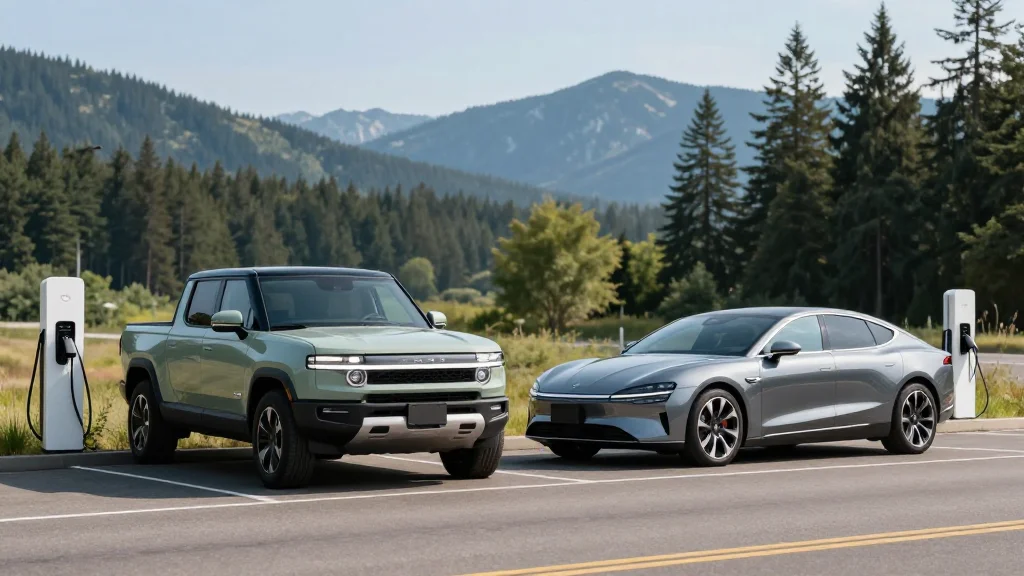
Rivian and Lucid Win Right to Sell Their EVs Directly to Buyers in Washington State

Why It Matters
Direct‑to‑consumer sales give EV startups higher margins and tighter brand control, potentially reshaping the U.S. dealership model and pressuring legacy automakers.
Key Takeaways
- •Washington law now permits Rivian, Lucid direct EV sales
- •Dealers withdrew opposition after potential ballot initiative threat
- •Direct sales promise higher profitability and brand control
- •Traditional automakers argue law unfairly favors startups
- •Rivian eyes similar ballot drives in six other states
Pulse Analysis
The United States has long required new‑car sales to flow through independent franchised dealers, a rule designed to protect small‑business owners and preserve price competition. In Washington State, that framework collided with the business models of electric‑vehicle newcomers Rivian and Lucid, which have argued that a direct‑to‑consumer approach mirrors the retail strategy of tech giants like Apple. After a protracted legal battle, the state legislature approved a compromise that lifts the ban on direct sales for the two companies, provided they obey the same operational regulations that govern traditional dealerships. The change follows a threatened ballot measure that showed roughly 70 % voter support for direct sales.
For Rivian, the decision arrives at a pivotal moment as it prepares to launch a lower‑priced SUV aimed at stabilising earnings amid a broader slowdown in U.S. EV demand. Direct sales eliminate the dealer markup, improve margin visibility, and let the brand control pricing, service standards, and the customer experience from online ordering to after‑sales support. Lucid stands to gain similar efficiencies as it expands its luxury lineup. Consumers also benefit from a streamlined purchasing process, which recent polling suggests many prefer over the traditional haggling at franchise lots.
The Washington precedent could become a template for other states where franchise laws remain rigid. Rivian has already identified six additional jurisdictions—Arkansas, Ohio, Oklahoma, Montana, Nebraska and South Dakota—where ballot initiatives might replicate the outcome. Legacy manufacturers such as General Motors, Ford and Toyota have mounted a coordinated lobbying effort, warning that the exemption creates an uneven playing field and could eventually open the door to foreign competitors. As more EV makers test the direct‑sales model, regulators will need to balance dealer protections with the evolving expectations of a digitally savvy car‑buying public.
Rivian and Lucid Win Right to Sell Their EVs Directly to Buyers in Washington State
Comments
Want to join the conversation?
Loading comments...