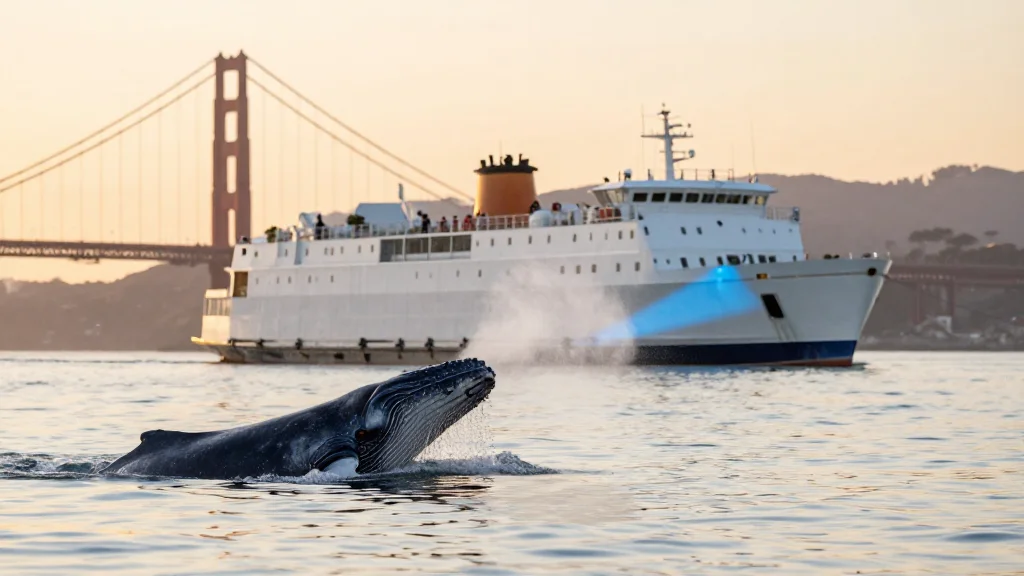
San Francisco Deploys AI 'WhaleSpotter' To Cut Ship‑Whale Collisions in Busy Bay

Why It Matters
The deployment of WhaleSpotter tackles two intersecting challenges: protecting a vulnerable marine species and enhancing maritime safety in one of the nation's busiest ports. By providing vessels with actionable, minutes‑ahead warnings, the system can lower the incidence of costly collisions, reduce downtime for ferries and cargo ships, and help operators meet increasingly stringent environmental regulations. For conservationists, the continuous data stream offers unprecedented insight into gray whale behavior, supporting adaptive management strategies as climate change reshapes migration routes. Beyond the Bay, WhaleSpotter sets a precedent for AI‑enabled wildlife monitoring in commercial shipping lanes worldwide. As global trade intensifies and marine traffic grows, scalable detection solutions could become a regulatory expectation, driving a new market for maritime AI services and prompting ports to invest in similar infrastructure to safeguard both ecosystems and economic throughput.
Key Takeaways
- •WhaleSpotter uses AI to detect gray whale blows and heat signatures up to 2 nm away.
- •System alerts ferries, cargo ships and tankers in real time, allowing course adjustments before collisions.
- •Gray whale deaths in the Bay rose to 21 in 2025, with 40% caused by ship strikes; at least 10 more deaths reported in 2026.
- •Population of eastern North Pacific gray whales has halved in 10 years, now about 13,000 individuals.
- •Pilot will run through 2026 whale season; performance metrics will guide potential expansion to other U.S. ports.
Pulse Analysis
WhaleSpotter arrives at a moment when AI is transitioning from data‑center hype to tangible, on‑the‑ground applications. Its hybrid architecture—combining fixed thermal cameras with vessel‑mounted sensors—mirrors the broader trend of edge‑AI deployments that process data locally to meet latency requirements. In the maritime sector, where safety margins are razor‑thin and regulatory scrutiny is tightening, such low‑latency alerts can become a competitive differentiator for operators seeking to minimize downtime and avoid costly fines under the Marine Mammal Protection Act.
Historically, ship‑whale collision mitigation has relied on static exclusion zones and voluntary speed reductions, which often clash with commercial schedules. WhaleSpotter’s data‑driven approach promises a more nuanced, dynamic solution that aligns ecological stewardship with operational efficiency. If the pilot demonstrates a measurable drop in strike incidents—say, a 30% reduction in reported collisions—it could catalyze policy shifts, prompting the U.S. Coast Guard and international bodies to endorse AI‑based alerting as a best practice. This, in turn, would open a niche market for vendors offering specialized maritime AI platforms, potentially spurring partnerships between tech firms, port authorities and environmental NGOs.
Looking ahead, the success of WhaleSpotter could accelerate the integration of AI into broader vessel traffic management systems, enabling automated route optimization that accounts for both commercial traffic density and wildlife movement. Such convergence would not only protect marine life but also enhance overall navigational safety, setting a template for other high‑traffic ecosystems—from the Baltic Sea’s porpoise corridors to the Indian Ocean’s dolphin habitats. The Bay’s experiment may thus become a bellwether for how AI can reconcile economic imperatives with the planet’s dwindling biodiversity.
San Francisco Deploys AI 'WhaleSpotter' to Cut Ship‑Whale Collisions in Busy Bay
Comments
Want to join the conversation?
Loading comments...