Supply Chain Market Maps: A Clearer View of Crowded Technology Markets
Why It Matters
By imposing a standardized evaluation structure, the Market Maps reduce procurement risk and accelerate technology adoption across the supply chain ecosystem. This clarity benefits both buyers seeking ROI‑focused solutions and vendors needing precise market positioning.
Key Takeaways
- •Market Maps categorize overlapping supply chain tech like WMS, AI, robotics
- •Buyers gain structured shortlists and internal alignment before vendor selection
- •Suppliers see clearer positioning and differentiation in crowded markets
- •Visual provider landscapes simplify comparison across multi‑enterprise platforms
- •Framework applies consistent analyst‑defined criteria for objective evaluation
Pulse Analysis
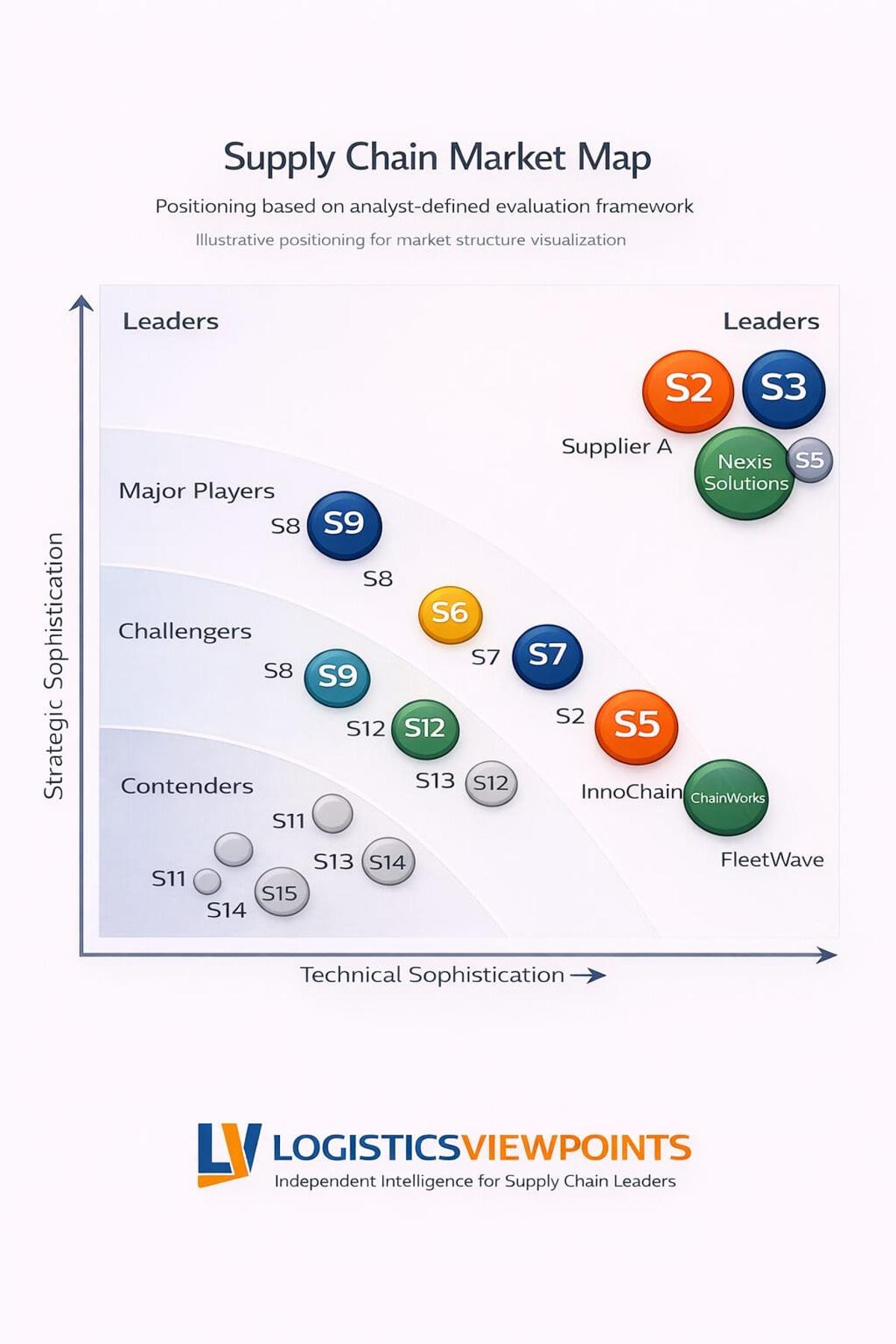
The supply chain technology arena has exploded in recent years, with solutions ranging from warehouse management systems to autonomous robotics and AI‑driven planning tools. This rapid expansion has blurred traditional category lines, leaving procurement teams wading through inconsistent vendor language and overlapping capabilities. Logistics Viewpoints’ Supply Chain Market Maps address this confusion by establishing a clear market scope for each technology segment and positioning providers on a unified analytical grid. The visual maps act as a compass, guiding buyers through a sea of options and highlighting where true differentiation lies.
For buyers, the value proposition is immediate: a structured framework that supports category education, provider shortlisting, and internal consensus building before any formal selection process. The maps deliver a curated set of vendors, each evaluated against consistent criteria such as functionality depth, integration ease, and scalability. Suppliers, meanwhile, receive a transparent external view of how they stack up against peers, enabling more precise go‑to‑market messaging and strategic partnership decisions. By standardizing the evaluation language, both sides can move past marketing hype and focus on measurable outcomes.
The broader industry impact is significant. As companies accelerate digital transformation initiatives—investing heavily in AI, autonomous trucking, and omnichannel fulfillment—the need for disciplined comparison becomes a competitive advantage. Market Maps help organizations allocate capital more efficiently, reduce implementation risk, and achieve faster ROI on technology spend. For investors and analysts, the maps provide a macro‑level lens to assess market saturation, emerging leaders, and potential consolidation opportunities, shaping the future trajectory of supply chain innovation.
Supply Chain Market Maps: A Clearer View of Crowded Technology Markets
Comments
Want to join the conversation?
Loading comments...