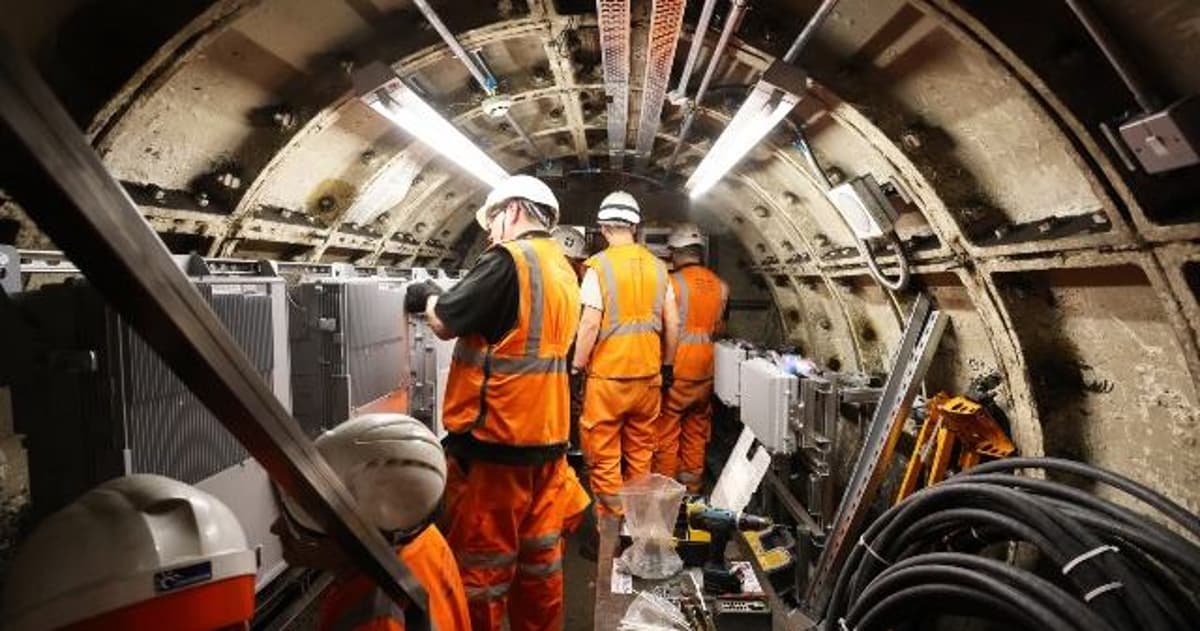
Surfing on the Tube
Companies Mentioned
Why It Matters
Reliable mobile service transforms commuter experience, creates new revenue streams for operators, and improves safety in a dense urban transit system. The neutral‑host approach proves scalable for legacy infrastructure worldwide.
Key Takeaways
- •Boldyn investing $1.35 bn to deliver 5G across all 121 tube stations
- •Neutral‑host DAS lets three UK operators share infrastructure, cutting costs
- •62 stations live; full coverage slated for end‑2026
- •Installation requires nightly 3‑hour windows in historic stations
- •Base‑station hotels act as mini‑data centres, enabling multi‑operator connectivity
Pulse Analysis
London’s subway has long been a dead zone for mobile signals, frustrating commuters and limiting emergency communications. By laying a fiber backbone and deploying leaky‑feeder cables throughout tunnels, Boldyn Networks is turning the Underground into a high‑speed 5G corridor. The technical challenge is unique: cramped historic stations, clay‑filled tunnels and a relentless service schedule force engineers into tight, three‑hour nightly windows, demanding precise planning and rapid deployment. This effort not only restores connectivity but also future‑proofs the network for emerging services such as real‑time passenger information and IoT sensors that can monitor air quality and crowding.
The neutral‑host model underpins the project’s economics. Rather than each mobile operator installing its own equipment—a logistical nightmare in the Tube’s limited space—Boldyn provides a shared Distributed Antenna System that hosts base‑band units for EE, Virgin Media O2 and Vodafone Three. This shared infrastructure cuts capital expenditure, reduces ongoing maintenance costs, and accelerates rollout timelines. Similar deployments are underway in New York’s MTA and San Francisco’s BART, but Boldyn’s plan to cover all 121 stations will likely become the world’s largest DAS, setting a benchmark for other legacy transit networks.
With 62 stations already live and full coverage expected by late 2026, the impact on London’s 1.7 billion annual passenger journeys will be significant. Commuters will enjoy uninterrupted voice, video and data services, enhancing productivity and safety. Operators gain a new platform for premium data services, location‑based advertising and emergency alerts. Moreover, the network’s backbone can support smart‑city applications, from predictive maintenance of rail assets to crowd‑flow analytics, positioning the London Underground as a digital infrastructure hub for the capital’s next decade.
Surfing on the Tube
Comments
Want to join the conversation?
Loading comments...