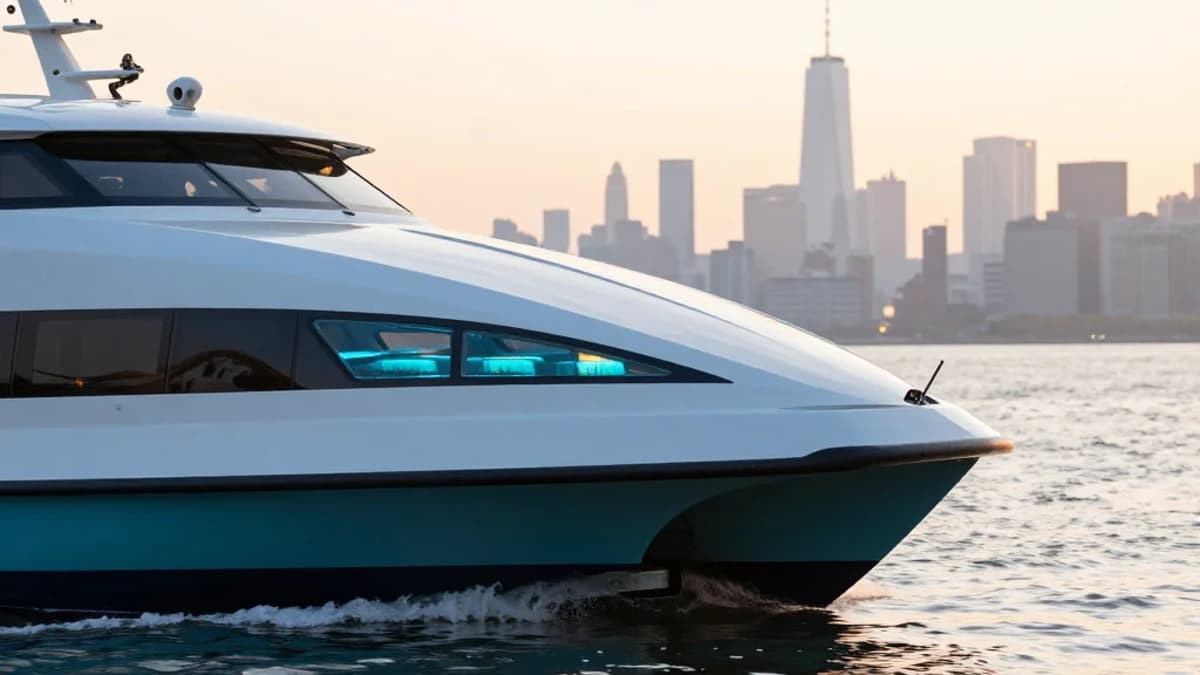
Switch Maritime, Incat Crowther Hydrogen Fuel Cell-Electric Ferry Hits Design Stage
•March 2, 2026
0
Why It Matters
The ferry provides a scalable zero‑emission model for high‑frequency commuter routes, cutting maritime carbon emissions while preserving existing service patterns. Its success could catalyze broader hydrogen adoption in U.S. and global ferry markets.
Key Takeaways
- •28‑meter ferry stores 720 kg compressed hydrogen.
- •150 passengers, 25 knots, full‑day operational range.
- •No shore‑side charging; uses diesel‑like service schedule.
- •$2 million NYSERDA grant supports development.
- •Demonstration ZEF‑150 to launch at Brooklyn Navy Yard.
Pulse Analysis
Decarbonizing short‑haul maritime transport has become a priority for coastal cities, and New York’s partnership with Switch Maritime and Incat Crowther signals a concrete step toward that goal. Hydrogen fuel‑cell propulsion offers higher energy density than batteries, enabling ferries to match diesel‑like speeds and ranges without the weight penalties of large battery packs. By storing 720 kg of compressed hydrogen, the 28‑meter vessel can complete a full day of service on existing routes, sidestepping the need for costly shore‑side charging infrastructure that has hampered electric ferry rollouts elsewhere.
The design leverages a “drop‑in” architecture that integrates seamlessly with current ferry operations. Operators can maintain familiar bunkering schedules, service speeds, and turnaround times, eliminating the operational disruptions often associated with new propulsion systems. The inclusion of a ZEF‑150 demonstrator at Brooklyn Navy Yard provides a real‑world testbed for safety, regulatory compliance, and performance validation, while the $2 million NYSERDA grant underscores public‑sector confidence in hydrogen’s viability for mass transit. This approach mirrors the successful Sea Change ferry in California, proving that the technology can be replicated across diverse markets.
If the New York pilot proves reliable and cost‑effective, it could unlock a wave of hydrogen‑powered ferries in dense commuter corridors worldwide. The combination of zero‑emission operation, comparable diesel performance, and minimal infrastructure upgrades presents a compelling business case for transit agencies facing tightening emissions regulations. However, scaling will depend on hydrogen production, supply chain logistics, and continued policy support. Nonetheless, the project positions hydrogen as a serious contender in the maritime decarbonization toolkit, potentially reshaping the economics of commuter ferry services for the next decade.
Switch Maritime, Incat Crowther hydrogen fuel cell-electric ferry hits design stage
0
Comments
Want to join the conversation?
Loading comments...