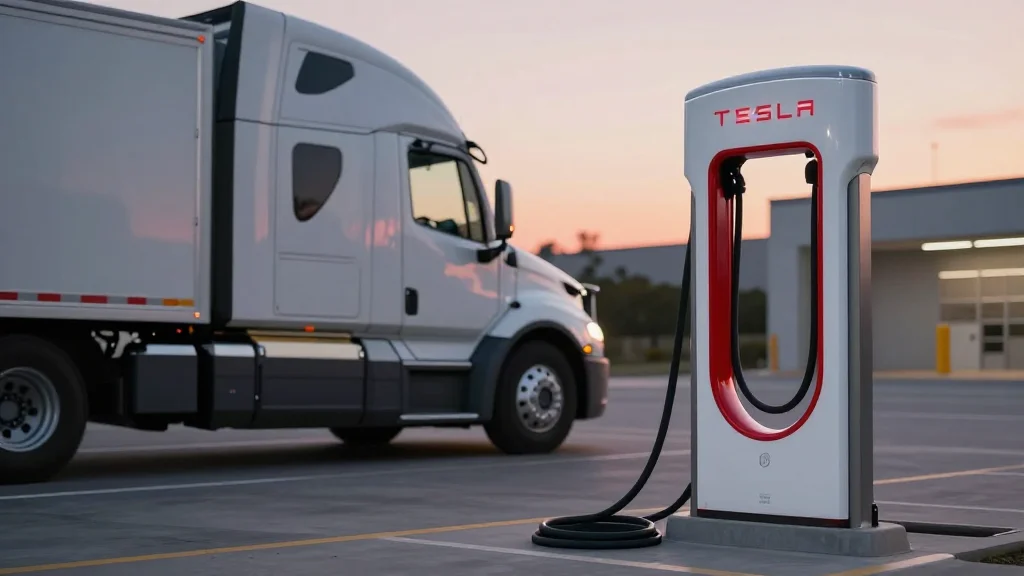
Tesla Launches Basecharger for Semi, Reveals $188,000 Megacharger
Why It Matters
The pricing and open‑standard approach accelerate electric‑truck infrastructure, making depot charging affordable and encouraging broader industry adoption beyond Tesla’s own fleet.
Key Takeaways
- •Megacharger starts at $188,000 for two 1.2 MW posts
- •Basecharger offers 125 kW for $40,000, targeting depot charging
- •Tesla charges $0.08/kWh, undercutting its Supercharger business rate
- •Open MCS 3.2 standard enables non‑Tesla trucks to use chargers
- •66 Megacharger sites planned, expanding Tesla’s electric truck network
Pulse Analysis
Tesla’s entry into the commercial‑truck charging market marks a strategic shift from pure vehicle manufacturing to full‑stack energy services. By bundling the high‑power Megacharger with the more modest Basecharger, the company addresses two distinct use cases: rapid top‑ups during mandatory driver rest periods and cost‑effective overnight charging at depots. The transparent pricing—$188,000 for a dual‑post Megacharger and $40,000 for a Basecharger—provides fleet operators with clear capital cost expectations, while the $0.08/kWh electricity fee positions Tesla as a price‑leader against its own Supercharger for Business offering.
Technical specifications underscore Tesla’s intent to make its chargers universally accessible. Both units adopt the MCS 3.2 standard and support ISO 15118‑2 and OCPI protocols, eliminating the proprietary lock‑in that once limited Tesla’s charging ecosystem. This openness allows manufacturers such as Daimler, Volvo and Scania to plug their electric trucks into Tesla‑installed sites, potentially turning Tesla’s network into a shared public utility for the broader industry. The Basecharger’s 125 kW output, comparable to a heavy‑duty Level‑2 charger, requires far less electrical infrastructure than megawatt‑class stations, making it attractive for warehouses and distribution centers where space and power capacity are limited.
In the competitive landscape, Tesla faces early movers like Kempower, ABB and ChargePoint, all of which have announced MCS‑compatible hardware but have yet to achieve scale in the United States. Tesla’s vertical integration—building trucks, chargers, and the network—gives it a logistical advantage and the ability to crowdsource infrastructure through its Semi Charging for Business program. With 66 Megacharger locations slated and partnerships such as Pilot Travel Centers already in place, Tesla is poised to shape the economics of electric‑truck fleets, lowering both upfront hardware costs and per‑kilowatt‑hour pricing, thereby accelerating the transition to zero‑emission freight.
Tesla launches Basecharger for Semi, reveals $188,000 Megacharger
Comments
Want to join the conversation?
Loading comments...