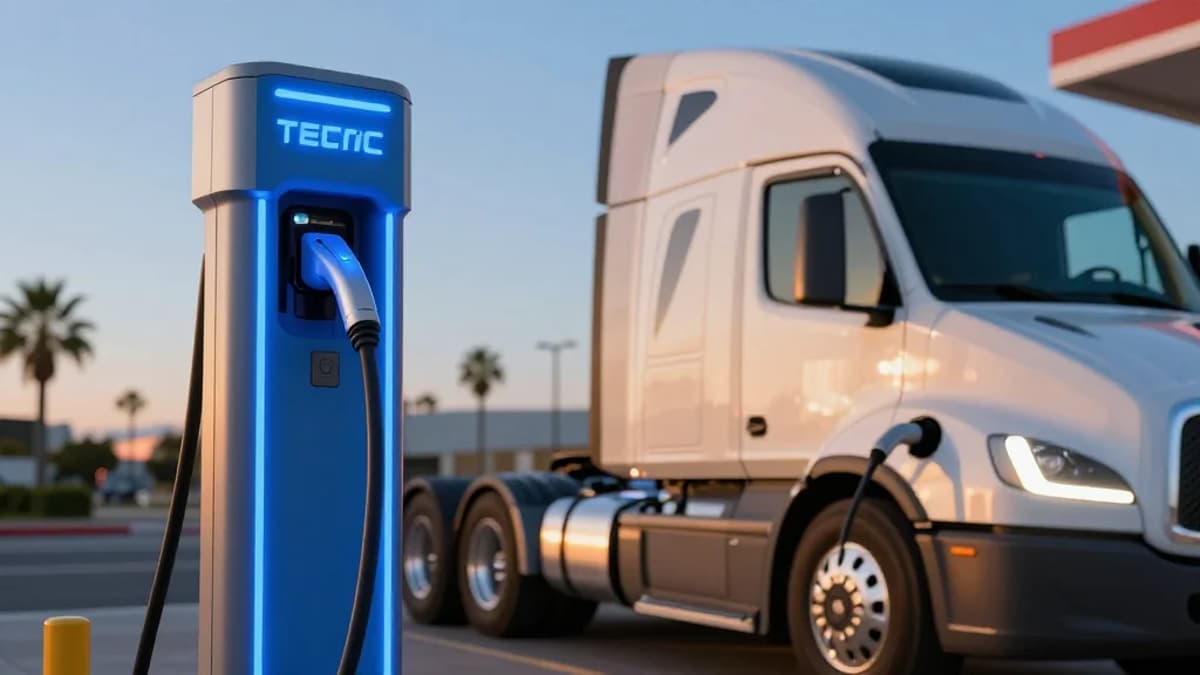
Tesla Opened Its First Semi Truck Megacharger That's Not At A Tesla Factory
•March 9, 2026
0
Why It Matters
A public Megacharger network is essential for scaling electric freight and reducing range anxiety, directly influencing the Tesla Semi’s market competitiveness. It also demonstrates Tesla’s intent to monetize high‑power charging infrastructure beyond passenger vehicles.
Key Takeaways
- •First public Tesla Megacharger opened in Ontario, California.
- •Provides 750 kW, slower than other Megachargers.
- •Part of plan for 64 U.S. public Megachargers.
- •Enables Semi to charge 60% in ~30 minutes.
- •Supports upcoming volume production of Tesla Semi.
Pulse Analysis
Tesla’s charging strategy has long been anchored by its ubiquitous Supercharger network, which helped the brand dominate the U.S. passenger EV market. The introduction of Megachargers marks a deliberate shift toward ultra‑high‑power stations designed for commercial vehicles. By situating the first public Megacharger at a travel center in Ontario, California, Tesla signals that its high‑capacity charging solution is moving beyond factory sites and into the broader logistics ecosystem, paving the way for broader adoption of electric freight.
The Ontario Megacharger delivers 750 kW, a substantial step up from the 350 kW peak of the latest Superchargers but below the 1.2 MW capacity of Tesla’s earlier pilot sites. This power level enables the Semi’s massive battery pack to reach 60 % state‑of‑charge in roughly half an hour—enough for a 500‑mile range. For fleet operators, such rapid top‑ups translate into tighter delivery schedules and lower downtime, addressing a core barrier to electric trucking. Moreover, the ability to charge six Model 3s to full capacity in the same timeframe underscores the scalability of Tesla’s megawatt‑level architecture.
Strategically, the rollout of at least 64 public Megachargers across the United States aligns with Tesla’s push to transition the Semi from pilot to volume production. A dense, reliable charging network reduces range anxiety, making the Semi a viable alternative to diesel haulage and strengthening Tesla’s position against emerging electric truck competitors. The public‑facing infrastructure also opens a new revenue stream, as third‑party logistics firms and independent fleets can access high‑power charging for a fee, further embedding Tesla’s ecosystem into the commercial transport sector.
Tesla Opened Its First Semi Truck Megacharger That's Not At A Tesla Factory
0
Comments
Want to join the conversation?
Loading comments...