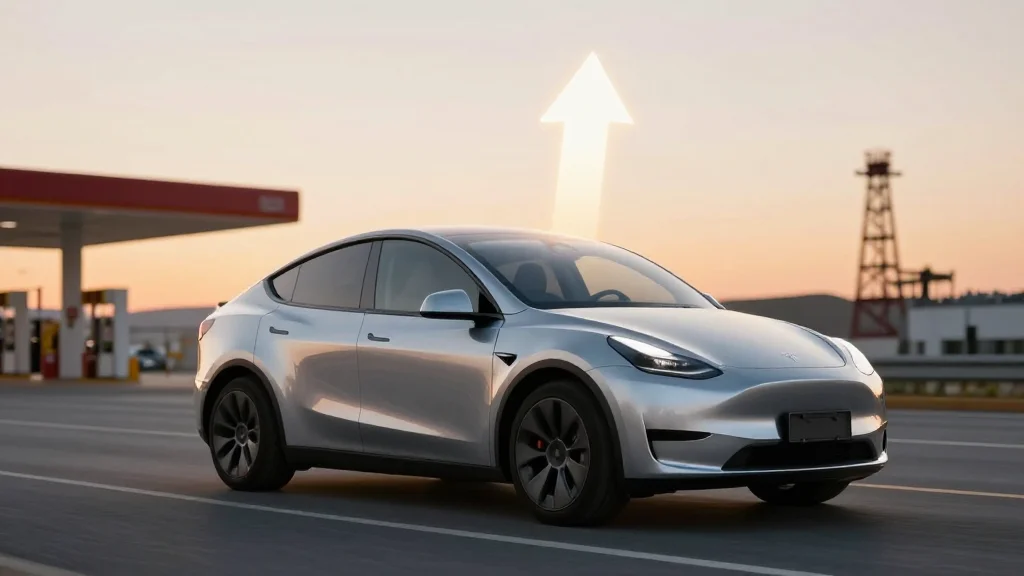
Tesla Raises U.S. Model Y Prices. Its Stock Just Forged A Lower Buy Point.
Companies Mentioned
Why It Matters
Higher Model Y prices reflect Tesla’s confidence in demand and its need to offset rising battery costs, while the emerging buy point could attract value‑oriented investors amid market volatility.
Key Takeaways
- •Model Y Premium RWD now $45,990; AWD $49,990.
- •Performance trim price rises $500 to $57,990.
- •First U.S. price hike in two years signals stronger demand.
- •Tesla stock dips 4.75% but new lower buy point emerges.
- •Battery cost pressures and gasoline price spikes drive pricing strategy.
Pulse Analysis
The price adjustment on Tesla’s Model Y underscores a shifting market dynamic where electric‑vehicle demand is buoyed by soaring gasoline prices linked to geopolitical tensions, notably the Iran war. Consumers facing higher fuel costs are increasingly viewing EVs as cost‑effective alternatives, allowing manufacturers like Tesla to test price elasticity without risking sales volume. At the same time, lithium price surges have squeezed battery margins, prompting automakers to pass a portion of those costs onto buyers, especially on higher‑margin premium trims.
From an investor standpoint, the stock’s 4.75% slide masks a technical opportunity. Chart analysts point to a cup‑with‑handle formation that establishes a new buy zone around $498 on the daily chart and $453 on the weekly chart, levels that historically precede upward moves for high‑growth stocks. This lower entry point may appeal to contrarian investors seeking exposure to Tesla’s long‑term growth narrative while the market digests short‑term pricing and supply‑chain pressures. The juxtaposition of a price hike and a depressed share price creates a rare risk‑reward profile.
The broader industry feels the ripple effects. Panasonic, Tesla’s primary battery partner, recently upgraded its EV battery outlook, citing the sales bounce as validation of demand despite cost headwinds. As Tesla phases out the Model S and Model X, the premium Model Y variants become its flagship offerings, potentially reshaping competitive pricing across the compact SUV segment. Competitors will watch Tesla’s pricing signals closely, balancing their own battery procurement strategies against consumer price sensitivity in a market where EV adoption is accelerating faster than supply‑chain constraints can be resolved.
Tesla Raises U.S. Model Y Prices. Its Stock Just Forged A Lower Buy Point.
Comments
Want to join the conversation?
Loading comments...