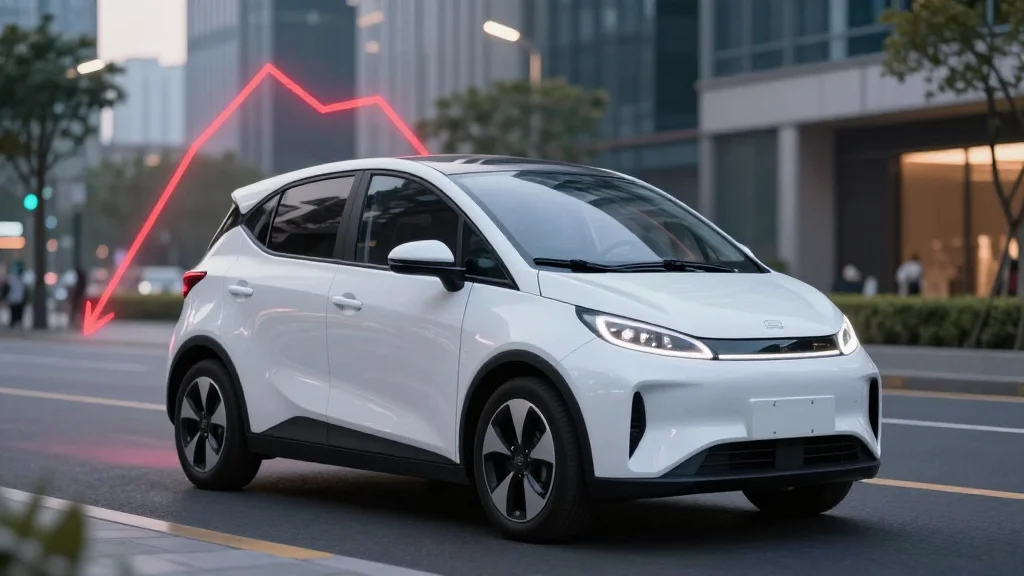
Tesla Rival Becomes First Chinese EV Company To Make Robotaxis. Both Stocks Fall.
Companies Mentioned
Why It Matters
Mass production signals that XPeng is ready to scale autonomous ride‑hailing, challenging Tesla’s early lead and potentially reshaping urban mobility economics. The development also tests the viability of vision‑only autonomy at commercial scale.
Key Takeaways
- •XPeng began mass‑producing robotaxis on its Guangzhou line
- •Vehicles use XPeng’s GX platform with four in‑house Turing chips
- •Both XPeng and Tesla rely on vision‑only autonomous systems
- •XPeng shares fell ~4% after the announcement, hitting 2025 lows
- •Pilot robotaxi service slated for H2 2026, full rollout early 2027
Pulse Analysis
XPeng's Guangzhou factory rolled out the first Chinese‑made robotaxi built entirely in‑house, marking a watershed for the domestic EV sector. The GX platform, equipped with four proprietary Turing chips, is engineered for Level 4 autonomy within defined zones, allowing the cars to operate without a safety driver. By achieving serial production, XPeng moves from pilot testing to a scalable supply chain, directly challenging Tesla's Cybercab rollout in the United States. The announcement underscores China's ambition to lead the next wave of mobility services, where high‑volume, low‑cost autonomous fleets could reshape urban transportation.
Both XPeng and Tesla have bet on a vision‑only sensor suite, discarding lidar in favor of camera arrays and neural‑network processing. Proponents argue that mimicking human sight reduces hardware costs and simplifies integration, while critics warn that the lack of redundant perception layers raises safety concerns, especially in complex weather. XPeng's decision has already influenced legacy manufacturers; Volkswagen has incorporated the same vision‑only stack into several models as part of a broader alliance. The industry’s gradual convergence on camera‑centric designs suggests a tipping point, but regulatory scrutiny and real‑world performance will determine whether the approach can scale safely.
The market reaction was mutedly negative: XPeng ADRs slipped about 4% to their lowest level since early 2025, and the broader Chinese EV sentiment remains fragile amid weaker macro data. Tesla shares also dipped, reflecting investor anxiety over intensified competition in the robotaxi arena. Analysts stress that revenue generation will be the ultimate test; pilot services are expected in Guangzhou later this year, with fully unsupervised fleets targeted for early 2027. If XPeng can monetize at scale, the company could narrow Tesla’s lead and attract capital, but the path remains capital‑intensive and regulatory‑heavy.
Tesla Rival Becomes First Chinese EV Company To Make Robotaxis. Both Stocks Fall.
Comments
Want to join the conversation?
Loading comments...