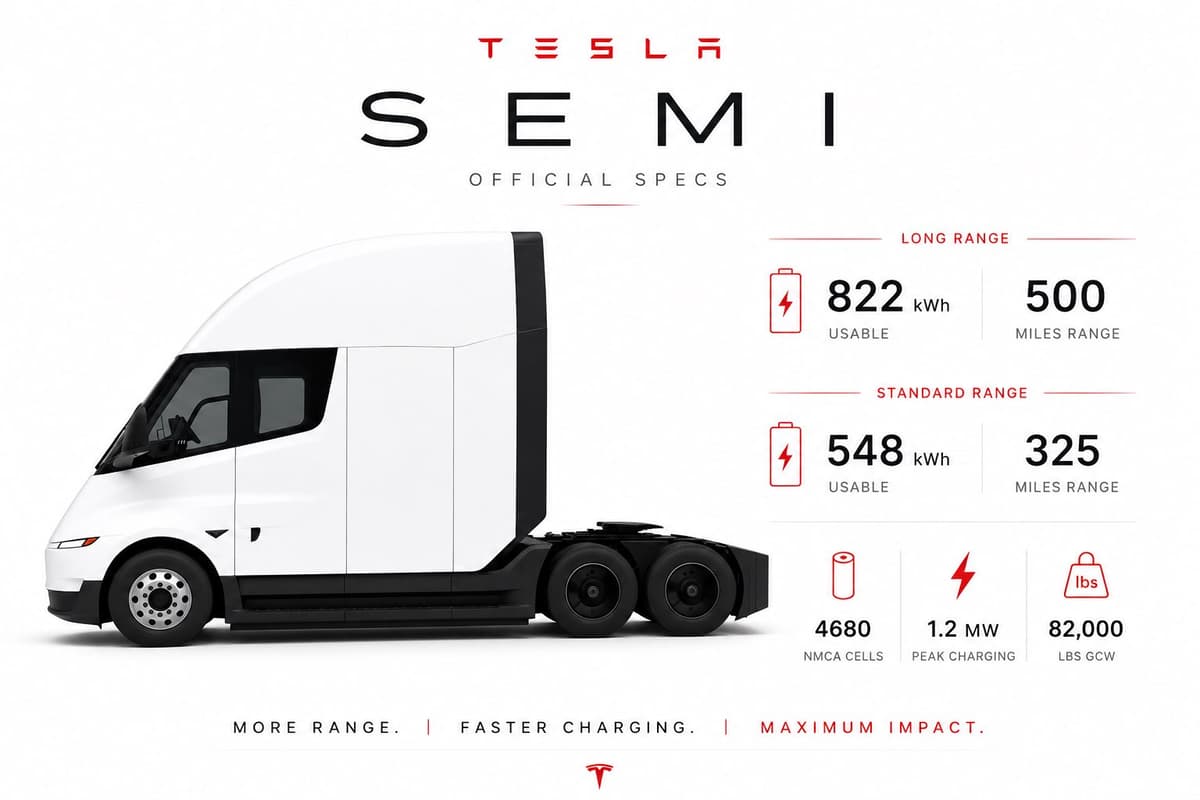
Tesla Semi and Megachargers Costs Versus Diesel

Key Takeaways
- •Tesla Semi hardware costs $1.23‑$3.09 M vs diesel $0.76‑$1.9 M.
- •Megacharger delivers up to 1,200 kW, Basecharger 125 kW.
- •Energy cost per 100k mi is $23.8k vs diesel $41.1k.
- •Payback for electric fleet ranges 8–9 years at current rates.
- •Federal IRA credits can further narrow cost gap.
Pulse Analysis
Tesla’s entry into the heavy‑duty charging market underscores a strategic push to make the Semi a viable alternative to diesel rigs. The Basecharger, priced at $40,000 for a pair, offers 125 kW of power—enough to restore roughly 60% of range in four hours—while the Megacharger’s 1,200 kW capacity targets high‑throughput depots. Both solutions bundle services and shipping, simplifying deployment for fleets, but they also raise the capital outlay considerably, especially when scaled to dozens of trucks.
Operating cost analysis reveals the real competitive edge. At a national electricity average of $0.14 per kilowatt‑hour, the Semi’s 1.7 kWh per mile translates to $23,800 per 100,000 mi, versus $41,100 for a diesel truck burning 9 mpg at $3.70 per gallon. This 42% energy‑cost advantage yields $17,300 in annual savings per vehicle, compressing the payback horizon to eight or nine years for a four‑truck, 500‑mile‑range fleet. Higher diesel prices or lower commercial electricity rates—potentially secured through solar or utility contracts—could halve that horizon, accelerating adoption.
For fleet operators, the calculus now extends beyond purchase price to total cost of ownership, regulatory pressure, and sustainability goals. Federal IRA tax credits for electric vehicles and charging infrastructure can shave hundreds of thousands off the effective price, while reduced maintenance—fewer moving parts, regenerative braking, and no oil changes—further improves margins. As charging networks mature and battery ranges extend, the economic case for electrifying long‑haul logistics strengthens, positioning Tesla’s Semi and its charging ecosystem as a catalyst for industry‑wide decarbonization.
Tesla Semi and Megachargers Costs Versus Diesel
Comments
Want to join the conversation?