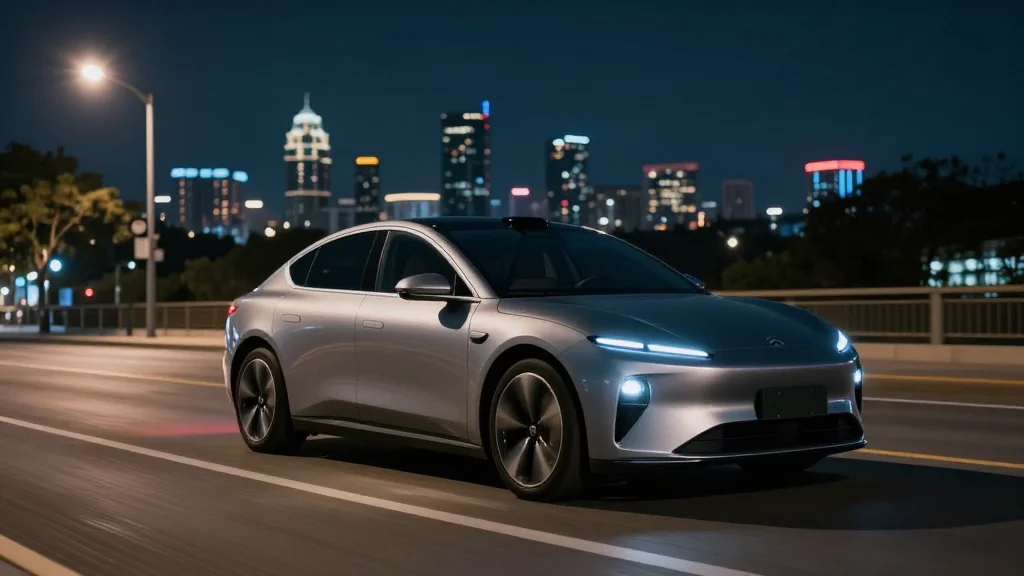
Tesla's Austin Robotaxi Fleet Begins Unsupervised Evening Service

Companies Mentioned
Why It Matters
The ability to run driver‑less robotaxis after dark marks a critical expansion of the technology’s operational envelope. Nighttime driving presents some of the toughest perception challenges for vision‑only systems, so proving safety and reliability in these conditions strengthens the case for broader regulatory acceptance. For the transportation sector, higher utilization translates into lower per‑ride costs, faster data collection, and a more compelling business case for autonomous fleets, potentially reshaping urban mobility economics. Beyond Tesla, the milestone puts pressure on competing autonomous‑vehicle developers to demonstrate comparable night‑time capabilities. If Tesla can maintain safety while scaling evening service, it could set a new industry benchmark that accelerates the overall rollout of driver‑less ride‑hailing across U.S. cities.
Key Takeaways
- •Tesla’s Austin robotaxi fleet began unsupervised evening operation on May 4, 2026
- •Evening runs align Austin with Dallas and Houston, expanding Texas coverage
- •Night‑time driving tests Tesla’s pure‑vision AI stack without lidar
- •Extended hours boost vehicle utilization and potential revenue
- •Milestone paves the way for near‑24‑hour service and expansion to new cities
Pulse Analysis
Tesla’s decision to unlock evening autonomous rides in Austin reflects a calculated risk‑reward balance. By first proving the technology in daylight and then incrementally adding low‑light scenarios, Tesla follows a staged validation approach that mirrors traditional aerospace certification pathways. The move also leverages the company’s massive data advantage: each additional hour of unsupervised operation multiplies the volume of real‑world edge cases fed into its neural networks, accelerating model convergence faster than competitors that rely on simulated data or lidar‑heavy stacks.
From a market perspective, the timing is strategic. Ride‑hailing demand spikes after work hours, and extending driver‑less service into that window can improve unit economics dramatically. Assuming an average fare of $15 per trip and a modest increase of two trips per vehicle per night, a fleet of 100 robotaxis could generate an extra $3,000 daily, or roughly $1 million annually. That revenue uplift, combined with the cost savings from eliminating human safety drivers, narrows the profitability gap that has long hampered autonomous‑vehicle business models.
However, the expansion also raises regulatory and public‑trust challenges. Nighttime incidents, even if rare, attract heightened scrutiny and can stall approvals in other jurisdictions. Tesla’s transparent communication—citing the tweet from the Robotaxi Tracker account—helps signal progress but does not replace formal safety reporting. Stakeholders will be watching safety metrics, insurance claims, and any local authority feedback closely. If Tesla can sustain a clean safety record while scaling evening service, it will not only cement its lead in the U.S. market but also set a template for global regulators evaluating autonomous mobility solutions.
Tesla's Austin Robotaxi Fleet Begins Unsupervised Evening Service
Comments
Want to join the conversation?
Loading comments...