Why It Matters
Fuel‑flexible tugs give owners a hedge against regulatory and market shifts, protecting investment returns and unlocking green‑finance opportunities. The approach sets a new benchmark for future‑proofing commercial vessels in a decarbonising maritime sector.
Key Takeaways
- •Damen's Fuel Flexible tugs can run on diesel, methanol, HVO, or batteries.
- •Vessels feature future‑proof class notation for methanol and ULEV systems.
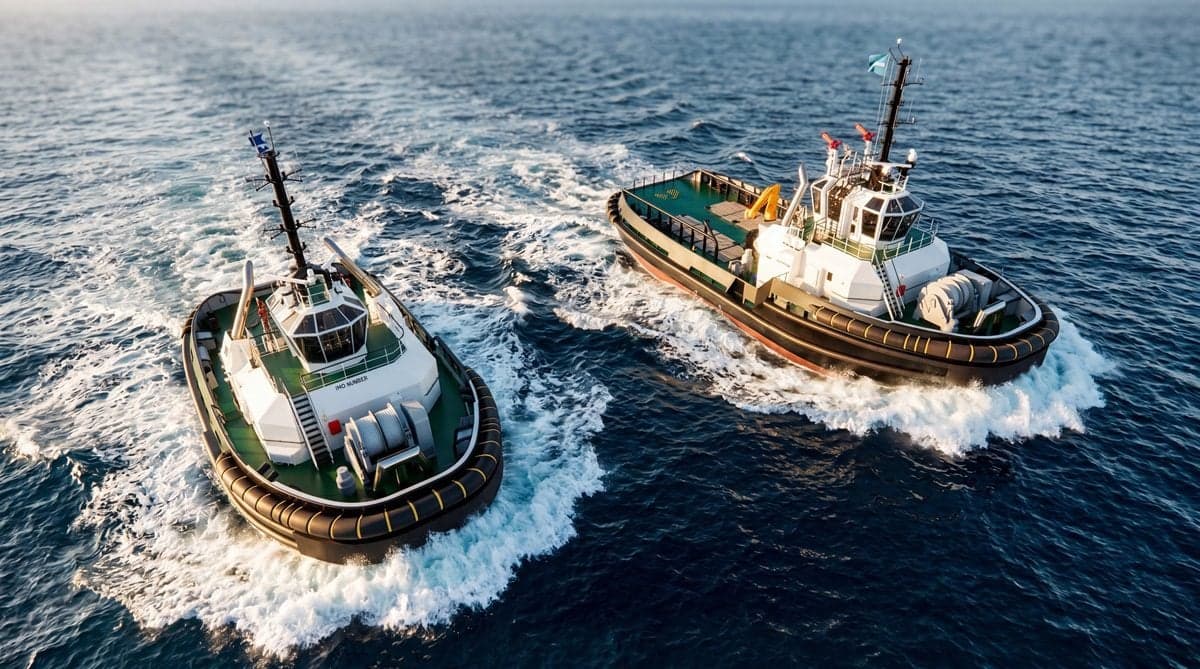
- •Launched 2713 FF (397 t) and 3313 FF (497 t) with 100 t pull.
- •Design adds space for future conversions, keeping CAPEX comparable per ton.
- •Flexibility aims to attract green financing and reduce long‑term retrofit costs.
Pulse Analysis
The maritime industry faces mounting pressure to decarbonise, yet the future fuel mix remains uncertain. Operators must balance today’s operational efficiency with tomorrow’s regulatory demands. Damen’s Fuel Flexible tug concept tackles this dilemma by delivering a vessel that meets current diesel‑powered performance while reserving the structural and systems capacity for low‑carbon alternatives such as hydrogen‑ready methanol, renewable HVO biofuel, or fully electric battery packs. This dual‑track strategy lets owners secure a working asset now and transition smoothly when greener fuels become economically viable.
Technically, the FF tugs incorporate methanol‑prepared class notation and space for a future Ultra Low Emission Vessel (ULEV) package that combines a diesel particulate filter with an IMO Tier III‑compliant SCR system, cutting NOₓ emissions by roughly 80 %. The design also allocates a dedicated battery compartment and shore‑power interface for zero‑emission port operations. By standardising tank dimensions for both diesel (≈126 m³) and methanol (≈115 m³) on the 2713 FF, and larger capacities on the 3313 FF, Damen ensures that fuel swaps involve minimal structural changes, preserving vessel stability and performance across propulsion options.
From a business perspective, the FF range is positioned to attract sustainability‑linked financing, as investors increasingly favour assets with clear decarbonisation pathways. Damen’s emphasis on keeping CAPEX per tonne of bollard pull comparable to conventional tugs mitigates upfront cost concerns, while the modular conversion approach defers major expenditures until market conditions clarify. This model reduces the risk of stranded assets and aligns with emerging carbon‑pricing mechanisms, offering operators a resilient, future‑ready solution that can adapt to evolving emissions standards without sacrificing profitability.
The future starts here
Comments
Want to join the conversation?
Loading comments...