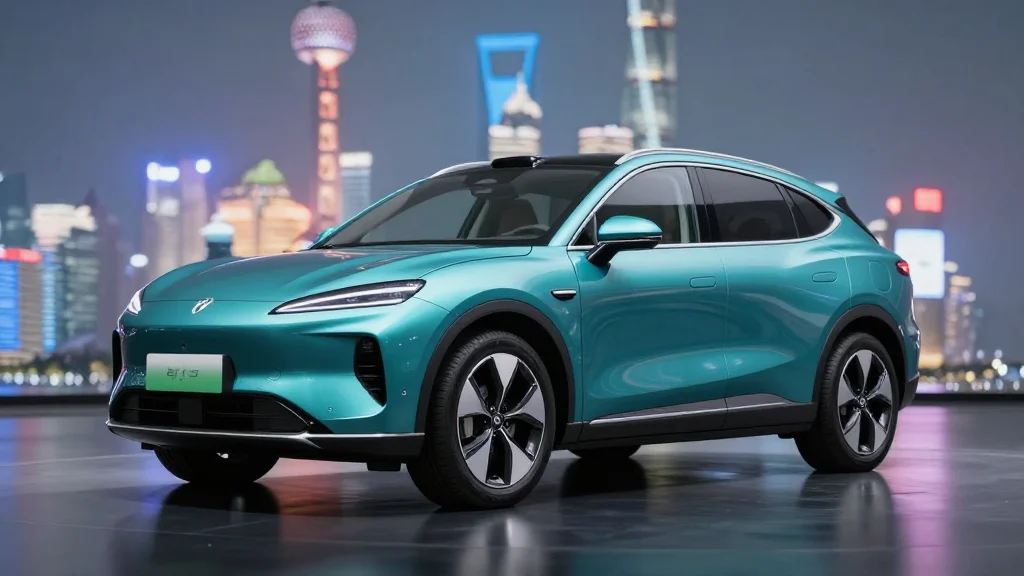
The Hyundai Ioniq V Blends Swoopy Roof With Sharp Angles
Companies Mentioned
Why It Matters
The Ioniq V signals Hyundai’s aggressive push to regain market share in China’s ultra‑competitive EV segment, leveraging a dedicated platform and premium digital interior to attract discerning buyers. Its success will influence Hyundai’s global EV strategy and revenue outlook.
Key Takeaways
- •Hyundai's first China‑only Ioniq model, the wedge‑shaped Ioniq V
- •27‑inch 4K touchscreen dominates the passenger‑side dashboard
- •Claimed CLTC range exceeds 373 miles (600 km) on a single charge
- •Hyundai and BAIC invest $1.1 billion to roll out 20 new China EVs
- •Targeting 500,000 annual units by 2031 across its China lineup
Pulse Analysis
The Hyundai Ioniq V marks the South Korean automaker’s first dedicated electric sedan for the Chinese market, debuting at the 2026 Beijing Motor Show. Built on a purpose‑made EV platform, the 4.9‑meter‑long wedge‑shaped car blends a fast‑back roofline with a conventional trunk, echoing Hyundai’s new “Origin” design language. Inside, a 27‑inch 4K touchscreen stretches across the passenger‑side dash, while a head‑up display replaces a traditional instrument cluster. Hyundai claims a CLTC‑tested range of more than 373 miles (600 km), positioning the Ioniq V among the higher‑end Chinese EVs.
China’s EV market is fiercely competitive, with domestic brands delivering cutting‑edge specs at lower prices. Hyundai’s joint venture with BAIC is committing roughly $1.1 billion to roll out 20 new models over the next five years, a clear offensive to regain relevance. The Ioniq V’s long wheelbase and premium interior signal a shift toward higher‑margin offerings, while the lack of physical controls aligns with local consumer preferences for digital‑first cabins. However, the CLTC range figure is optimistic compared with EPA standards, suggesting real‑world mileage may be lower.
Beyond the Ioniq V, Hyundai aims to sell 500,000 units annually in China by 2031, a target that hinges on the success of upcoming models such as the Earth‑based SUV and midsize EVs with optional range extenders. If achieved, the volume would bolster Hyundai’s global EV ambitions and provide a buffer against slowing sales in other regions. While the vehicle is unlikely to appear outside China, the technology and design cues could filter into future global models like the Ioniq 3 and the Boulder pickup, reinforcing Hyundai’s diversified EV roadmap.
The Hyundai Ioniq V Blends Swoopy Roof With Sharp Angles
Comments
Want to join the conversation?
Loading comments...