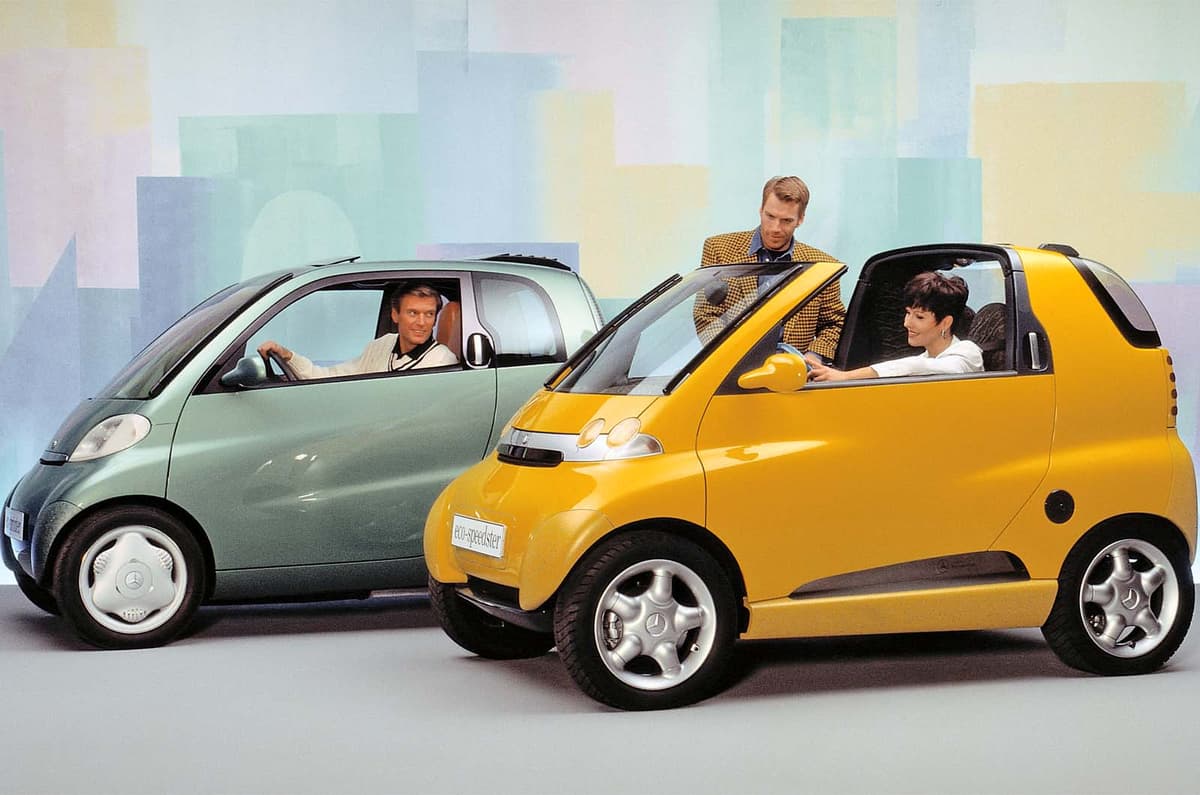
The Original City Slicker: The Smart Car's Journey From Swatch to #2
Why It Matters
Smart’s comeback underscores the persistent demand for ultra‑compact, low‑emission vehicles in congested cities and demonstrates how legacy collaborations can revive niche automotive segments, influencing both city planning and automakers’ micro‑mobility strategies.
Key Takeaways
- •Smart revives original two‑seat city car concept after 30 years
- •Originated from Hayek’s Swatchmobile and 1994 Mercedes‑Swatch joint venture
- •Initial £305m factory investment equals roughly $390 million today
- •Early hybrid design combined 250 cc engine with lead‑acid battery
- •Micro‑compact cars address urban congestion and low‑emission targets
Pulse Analysis
The Smart story began in the early 1990s when Swatch founder Nicolas Hayek envisioned a tiny, affordable electric vehicle he called the Swatchmobile. Priced at £3,570 (about $4,600) and designed to carry two people and two cases of beer, the concept attracted the attention of Volkswagen and later Mercedes‑Benz. In 1994, the two companies formed the Micro Compact Car (MCC) joint venture, marrying Swatch’s design flair with Mercedes’ engineering rigor. The collaboration produced a hybrid prototype featuring a 250 cc four‑stroke engine paired with a lead‑acid battery, and a bold plan for interchangeable body colors.
Mercedes‑Benz took the helm in 1995, rebranding the effort as Smart—S for Swatch, M for Mercedes, and ART for art’s sake. A dedicated factory in Hambach, France, was built at a cost of £305 million (approximately $390 million today), consolidating 30 suppliers on site to streamline production. The first Smart Fortwo rolled out in 1997, embodying the sandwich‑frame safety architecture of the A‑Class while delivering a minimalist, city‑friendly footprint. Though the early models struggled with range and price, the brand survived by carving out a niche for ultra‑compact urban mobility.
Today, Smart is tapping its heritage to launch a new two‑seat city car that mirrors the original Fortwo’s simplicity but embraces modern electric powertrains. As cities worldwide tighten emissions standards and grapple with traffic congestion, micro‑cars like Smart offer a pragmatic solution: low operating costs, minimal parking space, and zero tailpipe emissions. The revival signals to the broader automotive industry that there remains a viable market for sub‑compact EVs, prompting legacy manufacturers and startups alike to explore similar ultra‑small platforms for the next wave of sustainable urban transport.
The original city slicker: The Smart car's journey from Swatch to #2
Comments
Want to join the conversation?
Loading comments...