Why It Matters
The uptick raises operational costs, insurance premiums, and supply‑chain risk for global shippers, prompting firms to reassess routing and security strategies. Persistent piracy also threatens the reliability of critical energy and commodity flows through key maritime corridors.
Key Takeaways
- •MT Eureka hijacked May 2, taken toward Somalia.
- •Somali piracy incidents rose after naval focus shifted to Houthi attacks.
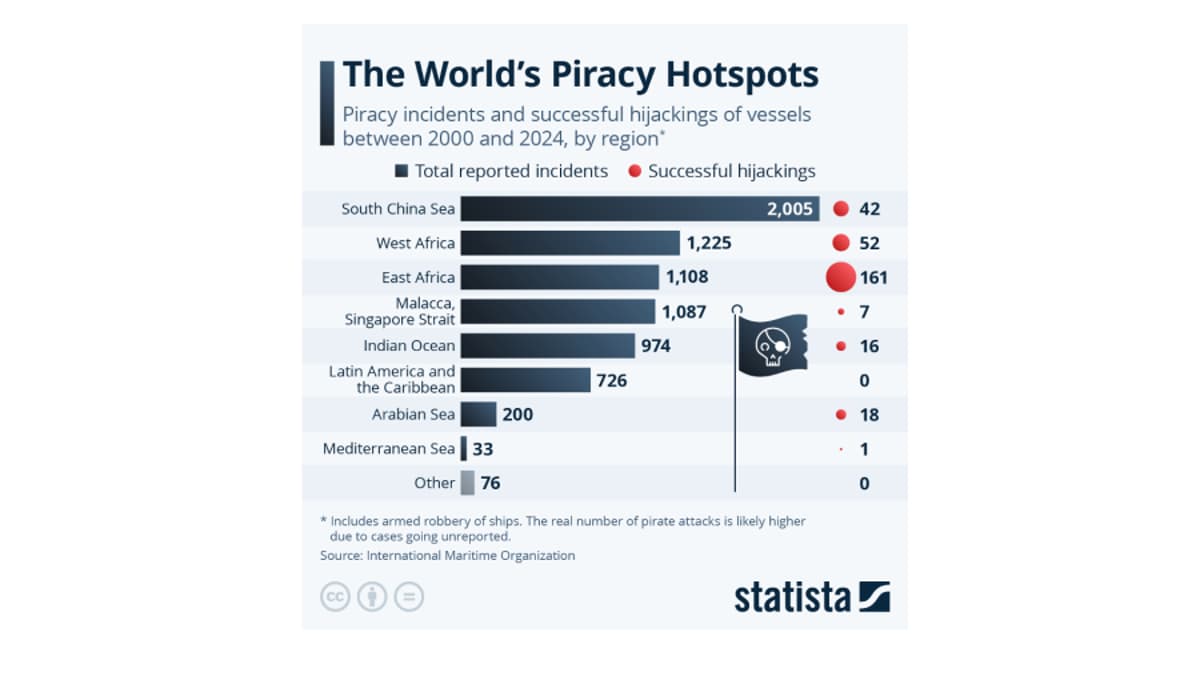
- •East Africa recorded 161 hijackings since 2000, highest global total.
- •South China Sea logged over 2,000 piracy incidents, mostly low‑level attacks.
- •Strait of Malacca attacks jumped to 91 in 2024, highest regional count.
Pulse Analysis
The latest hijacking of MT Eureka illustrates how shifting naval priorities can create security vacuums. As multinational fleets concentrate on counter‑Houthi operations and the strategic choke‑point of the Strait of Hormuz, Somali pirates have found breathing room to resume high‑value attacks. This dynamic illustrates the interconnected nature of maritime security: a flare‑up in one theater can inadvertently embolden illicit actors in another, forcing shipping companies to monitor geopolitical developments as closely as weather forecasts.
Statistical trends reveal a nuanced global piracy landscape. East Africa remains the historic epicenter, accounting for 161 successful hijackings since 2000, yet the South China Sea eclipses it in sheer incident volume, exceeding 2,000 attacks—most of which are opportunistic thefts rather than full‑scale seizures. Meanwhile, the Strait of Malacca, once on a downward trajectory after a 2015 peak, rebounded to 91 incidents in 2024, driven by night‑time robberies linked to local poverty. West Africa’s numbers have softened but still generate a disproportionate share of hostage‑taking and fatalities, underscoring regional socioeconomic drivers.
For the maritime industry, these patterns translate into tangible cost pressures. War‑risk and piracy insurance premiums are climbing, and operators are revisiting route planning to avoid high‑risk zones, sometimes opting for longer voyages that increase fuel consumption. Private security teams and hardened citadels on vessels are becoming standard, especially for ships transiting the Gulf of Aden and Malacca. Looking ahead, sustained international cooperation—combining naval patrols, intelligence sharing, and on‑shore economic development—will be essential to curb the resurgence and protect the arteries of global trade.
The world's piracy hotspots – Statista
Comments
Want to join the conversation?
Loading comments...