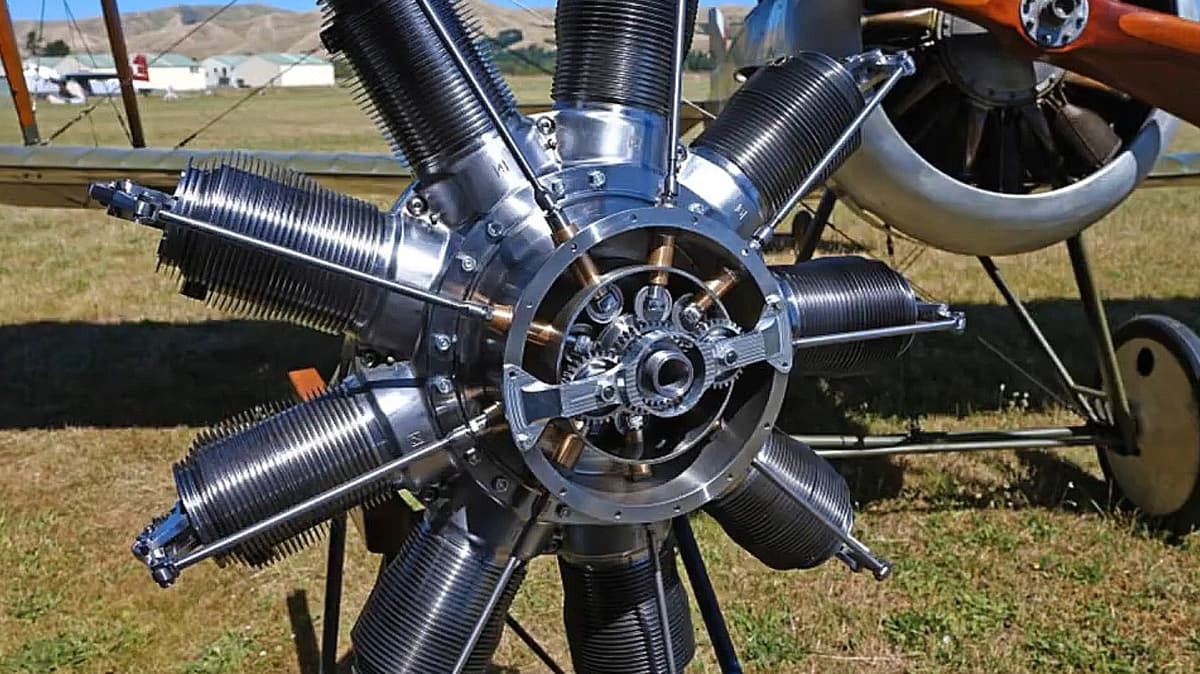
The World's Weirdest Rotary Engine Is A 118-Year-Old French Spinner That Leaks Castor Oil Everywhere
•March 1, 2026
0
Why It Matters
The engine proved that rotating‑cylinder designs could deliver reliable power for early flight, while exposing lubrication and handling issues that guided later propulsion engineering. Its historical footprint informs both preservation efforts and modern studies of unconventional engine concepts.
Key Takeaways
- •Generated ~50 hp at 1,200 rpm
- •Cylinders and crankcase rotated around stationary crankshaft
- •Used castor oil lubrication, spraying oil onto pilots
- •Over 20,000 units built by WWI end
- •Right-turn handling difficulty limited combat maneuverability
Pulse Analysis
Early aviation was a laboratory of bold ideas, and the Gnome Omega stands out as a hallmark of that experimental era. Introduced by the French Seguin brothers in 1908, the engine’s 8‑liter, seven‑cylinder layout turned the conventional engine concept on its head by rotating the entire cylinder block around a fixed crankshaft. This clever arrangement provided natural air‑cooling without a dedicated fan, allowing lightweight aircraft like the Sopwith Camel and Nieuport fighters to achieve reliable thrust at modest power levels. The Gnome’s simplicity—no carburetor, single‑valve cylinders, and a binary on/off ignition—made it attractive for mass production, resulting in over 20,000 units by the end of World War I.
The technical quirks of the Gnome were as famous as its performance. Its total‑loss lubrication system relied on castor oil, which, when flung outward by centrifugal force, coated pilots and airframes in a greasy film that could be both uncomfortable and, due to the oil’s laxative properties, hazardous. Moreover, the rotating mass created pronounced gyroscopic effects: pilots found left turns easy but struggled with right turns, a disadvantage in dogfights. Power output was capped around 50 horsepower, and scaling the design proved impractical, limiting its post‑war applicability and prompting a shift toward stationary‑cylinder inline and V‑type engines.
Today, the Gnome Omega lives in museums and the hands of dedicated hobbyists who rebuild replicas for static display or limited flight. Its legacy endures as a case study in engineering trade‑offs—balancing simplicity, cooling, and weight against control complexity and maintenance challenges. Modern engineers reference the Gnome when exploring unconventional propulsion, such as rotary or orbital concepts, because it illustrates how innovative mechanics can both solve and create new problems. The engine’s story also underscores the importance of lubrication technology, a lesson that continues to shape high‑performance aerospace powerplants.
The World's Weirdest Rotary Engine Is A 118-Year-Old French Spinner That Leaks Castor Oil Everywhere
0
Comments
Want to join the conversation?
Loading comments...