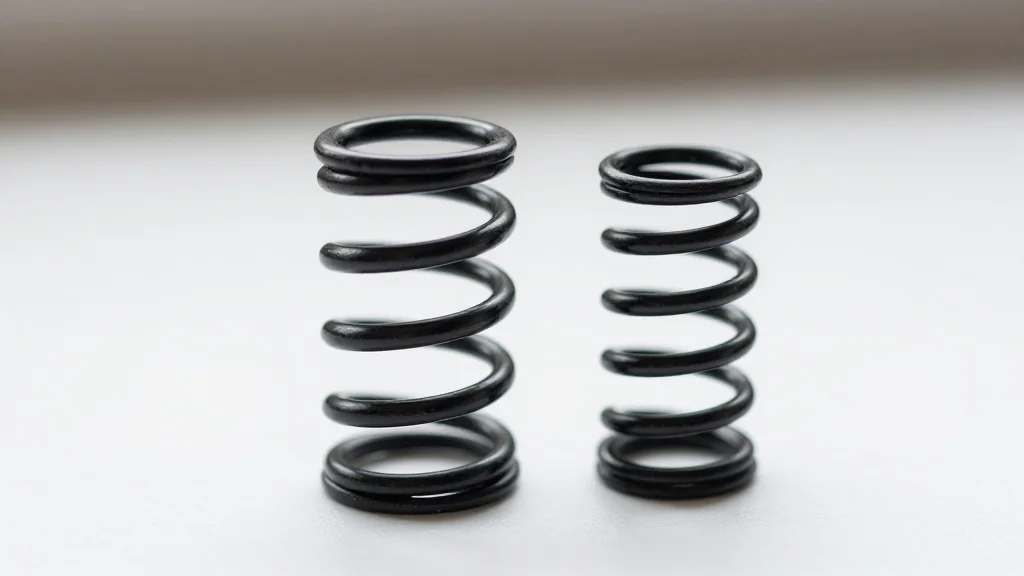
This Coil Spring Alternative Is Transforming Manufacturing
Why It Matters
By cutting spring height, manufacturers can shrink product footprints, lower weight, and achieve cost efficiencies that directly impact performance and profitability in highly competitive markets.
Key Takeaways
- •Wave springs cut spring height up to 50% versus coil springs
- •Flat‑wire design reduces axial space while maintaining load capacity
- •Lighter assemblies lower overall system weight and material costs
- •Higher unit price offset by savings in cavity and manufacturing
- •Ideal for tight radial/axial spaces, not for large travel loads
Pulse Analysis
Wave springs have emerged as a compact alternative to traditional helical coil springs, leveraging a flat‑wire geometry that folds into a series of sinusoidal waves. By bending rather than twisting, the spring stores energy in the curvature of each wave, allowing the same axial load to be generated in roughly half the free height. This axial space reduction is especially valuable in automotive powertrain modules, electric‑vehicle battery packs, and consumer electronics where every millimeter of envelope translates into design freedom and weight savings.
From a cost perspective, wave springs carry a higher per‑unit price, but the net system expense often declines. Smaller spring cavities free up material, simplify tooling, and reduce assembly time, which can shave millions of dollars from high‑volume production runs. OEMs in the aerospace sector have reported up to a 15 % reduction in component weight when substituting wave springs, while automotive manufacturers cite improved crash‑zone packaging and lower overall vehicle mass, directly supporting fuel‑efficiency targets.
Successful integration requires careful parameter matching—wave count, thickness, and material must be tuned to meet the target spring rate and deflection. Engineers should supply detailed load profiles and space constraints to spring vendors rather than assuming a one‑to‑one swap. As additive manufacturing matures, customized wave‑spring profiles could be printed on‑demand, further accelerating adoption. In the next decade, the combination of space‑saving mechanics and emerging production methods positions wave springs to redefine compression‑spring design across multiple high‑performance industries.
This Coil Spring Alternative Is Transforming Manufacturing
Comments
Want to join the conversation?
Loading comments...