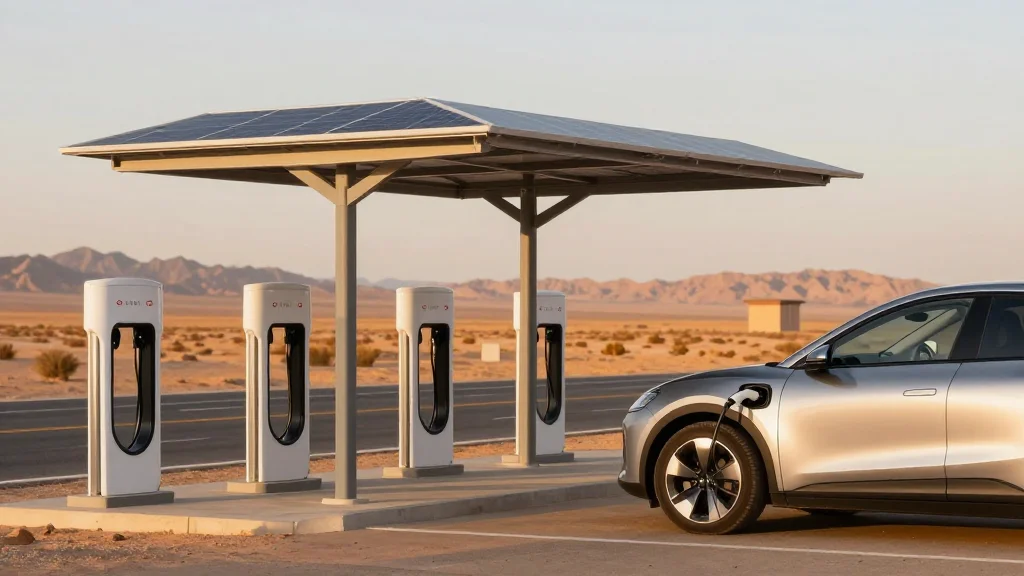
This EV Charging Station On Route 66 Is Off-Grid And Cheaper Than The Competition
Companies Mentioned
Why It Matters
The project proves that high‑speed, cost‑effective EV charging can be deployed quickly in remote areas without relying on expensive grid connections, accelerating EV adoption on underserved routes.
Key Takeaways
- •Coral Charge's Barstow station uses 600 solar panels for power.
- •Six DC fast chargers deliver up to 180 kW per vehicle.
- •Pricing at $0.50/kWh + $1 session undercuts local competitors.
- •Installation takes eight weeks versus 50 weeks for grid‑connected sites.
- •Built‑in 140 kWh batteries enable night‑time charging off‑grid.
Pulse Analysis
The new Coral Charge station in Barstow marks a milestone for off‑grid electric‑vehicle infrastructure. Powered entirely by roughly 600 photovoltaic panels, the site can serve six cars simultaneously with three DC fast chargers that each output up to 180 kW. Integrated battery packs store 140 kWh, allowing the chargers to operate after sunset without drawing from the utility grid. By placing solar‑driven power on historic Route 66, the startup demonstrates that reliable, high‑speed charging can thrive in remote desert corridors where traditional grid connections are costly or impractical.
Coral Charge’s pricing—$0.50 per kilowatt‑hour plus a $1 session fee—under‑cuts nearby non‑Tesla chargers, offering a clear economic incentive for drivers traversing the Mojave. The on‑site battery system not only smooths solar intermittency but also eliminates the need for expensive utility permits, slashing deployment time to eight weeks. By contrast, conventional California charging projects often require up to 36 weeks for permitting and a full year for construction. This speed advantage lowers capital risk and accelerates revenue generation for operators willing to adopt off‑grid models.
The Barstow installation signals a broader shift toward decentralized energy for mobility. As automakers expand high‑capacity connectors like CCS1 and NACS, the need for reliable, fast power sources grows, especially in regions where the grid is strained or absent. Off‑grid stations can be replicated quickly, leveraging modular solar‑panel arrays and standardized battery‑integrated chargers, potentially reducing the overall cost per kilowatt‑hour for the network. If regulators continue to streamline permitting, the model could accelerate EV adoption across the western United States, turning previously underserved stretches of highway into viable charging corridors.
This EV Charging Station On Route 66 Is Off-Grid And Cheaper Than The Competition
Comments
Want to join the conversation?
Loading comments...