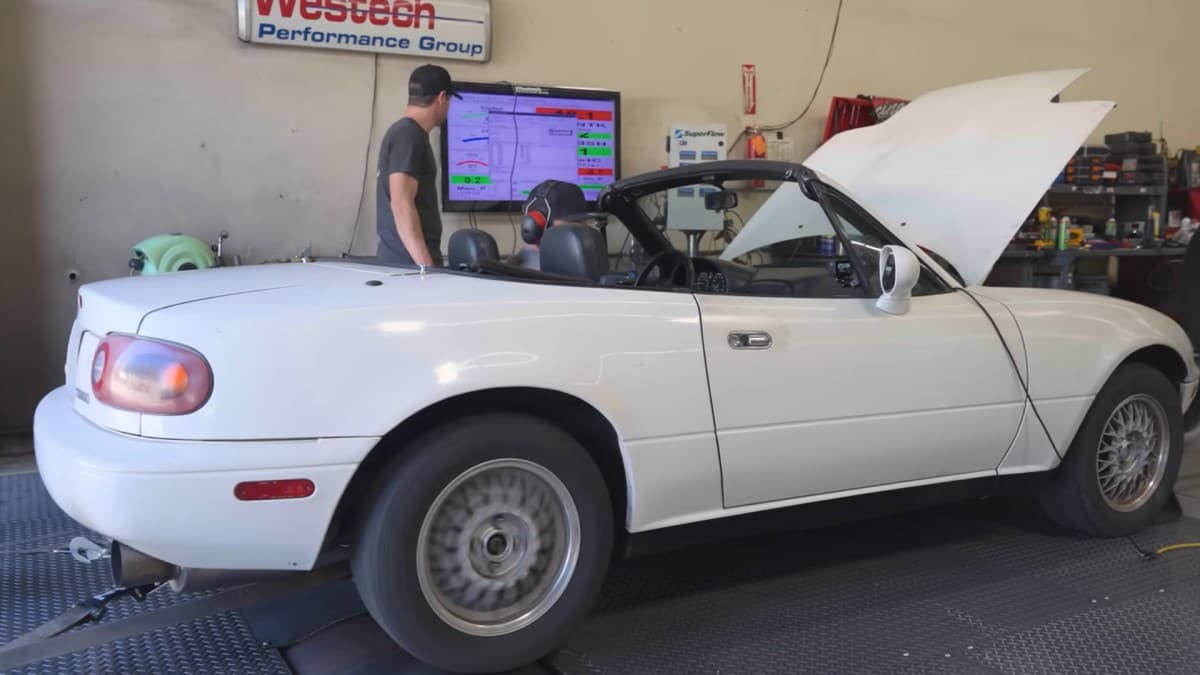
This Is What a One-Rotor Turbo Miata Making 155 HP Sounds Like
Why It Matters
The project demonstrates that a lightweight, turbo‑charged rotary can deliver respectable performance in a production sports car, highlighting the potential for niche, DIY power‑train innovations to influence aftermarket tuning trends.
Key Takeaways
- •Engine weighs ~70 lb, built almost entirely from billet aluminum
- •Garrett GBC‑22 turbo provides up to 22 psi boost, causing fuel spikes
- •Dyno test recorded 155 hp and 136 lb‑ft torque
- •3D‑printed intake manifold replaces traditional cast parts
- •Future tuning could push output beyond current figures
Pulse Analysis
Rotary engines have long occupied a cult niche among automotive enthusiasts, prized for their high revving character and compact size. Rob Dahm, a prominent YouTube engineer, has taken the concept to an extreme by constructing a single‑rotor powerplant from scratch. By machining the majority of components from billet aluminum, he achieved a remarkably low engine weight of about 70 pounds, a figure that rivals many high‑performance four‑cylinder units. This lightweight foundation, combined with a modern Garrett GBC‑22 turbo, showcases how advanced materials and forced induction can revive the rotary’s relevance in today’s performance market.
The Miata integration required several unconventional solutions. A 3D‑printed intake manifold was employed because off‑the‑shelf parts simply do not exist for a one‑rotor layout. On the dyno, the setup produced 155 horsepower and 136 lb‑ft of torque, impressive numbers given the engine’s modest displacement. However, the internal wastegate’s boost creep—spiking to roughly 22 psi—has led to excess fuel entering the oil catch can, indicating that the fueling map and turbo clearance need refinement. Dahm’s methodical approach to smoothing out these issues underscores the iterative nature of high‑performance engineering, where each data point drives the next round of adjustments.
Beyond the technical intrigue, the project signals broader implications for the aftermarket and DIY community. A functional turbocharged rotary that can reliably propel a street‑legal Miata suggests a pathway for enthusiasts to explore lightweight, high‑specific‑output builds without resorting to conventional engine swaps. As tuning progresses and power potential rises, the one‑rotor could inspire a new wave of custom applications, from track cars to limited‑run specialty vehicles. Dahm’s transparent documentation also provides a valuable knowledge base, encouraging other makers to experiment with additive manufacturing and bespoke turbo setups, ultimately enriching the performance‑engine ecosystem.
This Is What a One-Rotor Turbo Miata Making 155 HP Sounds Like
Comments
Want to join the conversation?
Loading comments...