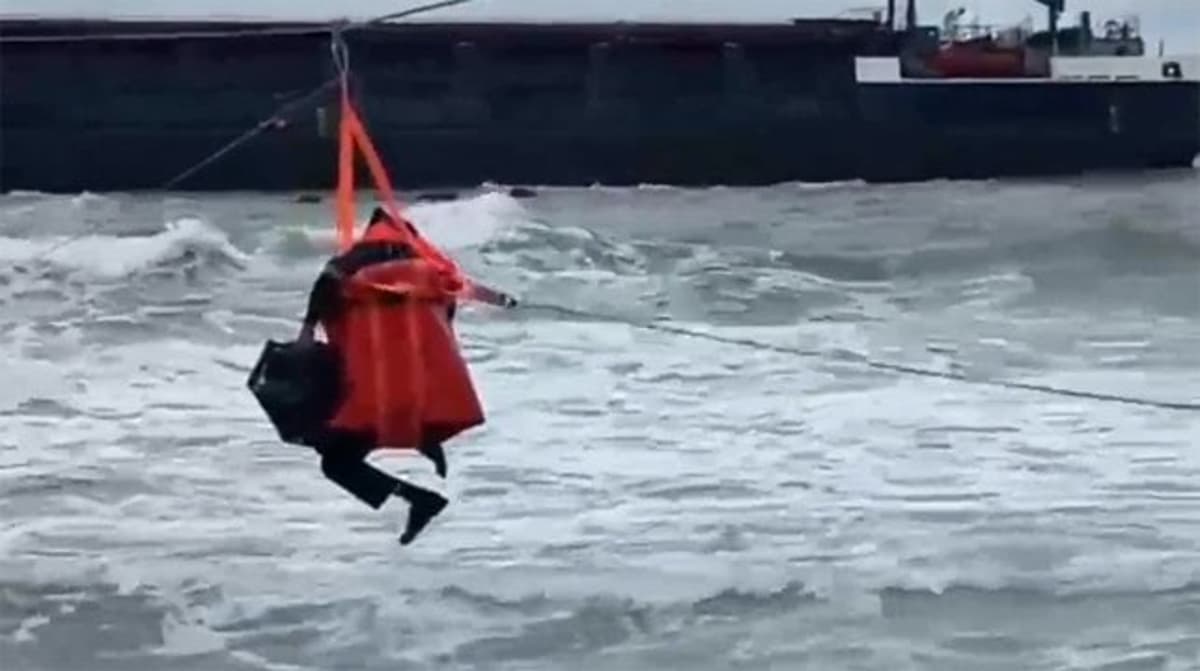
Turks Use Breeches Buoy to Rescue Crew From Grounded Cargo Ship
Why It Matters
The operation highlights the continued relevance of traditional rescue techniques in extreme weather and underscores regulatory gaps for aging, flag‑of‑convenience vessels with repeated safety violations.
Key Takeaways
- •Eight crew rescued via breeches buoy despite stormy conditions
- •Ninova, 2,500‑dwt vessel, ran aground near Sakarya on May 1
- •Ship’s ownership unclear; flagged in Cameroon, banned by Italy 2024
- •Multiple inspections cited 30+ safety deficiencies in 2025
- •Rescue coordinated by KEGM, Coast Guard, police, and fire services
Pulse Analysis
The Black Sea storm of early May 2026 tested Turkey’s maritime emergency response, forcing rescuers to revert to a centuries‑old technique: the breeches buoy. By firing a guideline from shore to the stranded Ninova and hauling crew members ashore one by one, authorities demonstrated that low‑tech solutions can outperform high‑tech assets when weather renders helicopters and vessels unusable. This incident reinforces the importance of maintaining proficiency in traditional rescue methods, especially in regions prone to sudden gale‑force winds and heavy surf.
Beyond the dramatic rescue, the Ninova episode spotlights systemic issues in global shipping oversight. The vessel, registered in Cameroon—a common flag of convenience—has been flagged for repeated safety shortcomings, culminating in an Italy‑issued ban under the Paris Memorandum of Understanding in 2024. Subsequent inspections by Russian and Turkish authorities logged over 30 deficiencies in 2025, yet the ship continued operating, illustrating gaps in enforcement and the challenges of tracking ownership for older vessels. The lack of transparent ownership further complicates liability and salvage decisions, raising questions about the efficacy of current international compliance frameworks.
For the broader industry, the incident serves as a cautionary tale about anchoring practices and vessel stability in volatile weather. Operators must reassess risk assessments for ships navigating the Black Sea corridor, especially those with aging hulls and questionable maintenance records. Coordinated multi‑agency responses, as seen with KEGM, the Coast Guard, police, and fire services, should become standard protocol to ensure rapid, safe evacuations. As climate change intensifies storm frequency, integrating both modern technology and proven manual techniques will be essential for safeguarding lives and mitigating environmental damage from stranded vessels.
Turks Use Breeches Buoy to Rescue Crew from Grounded Cargo Ship
Comments
Want to join the conversation?
Loading comments...