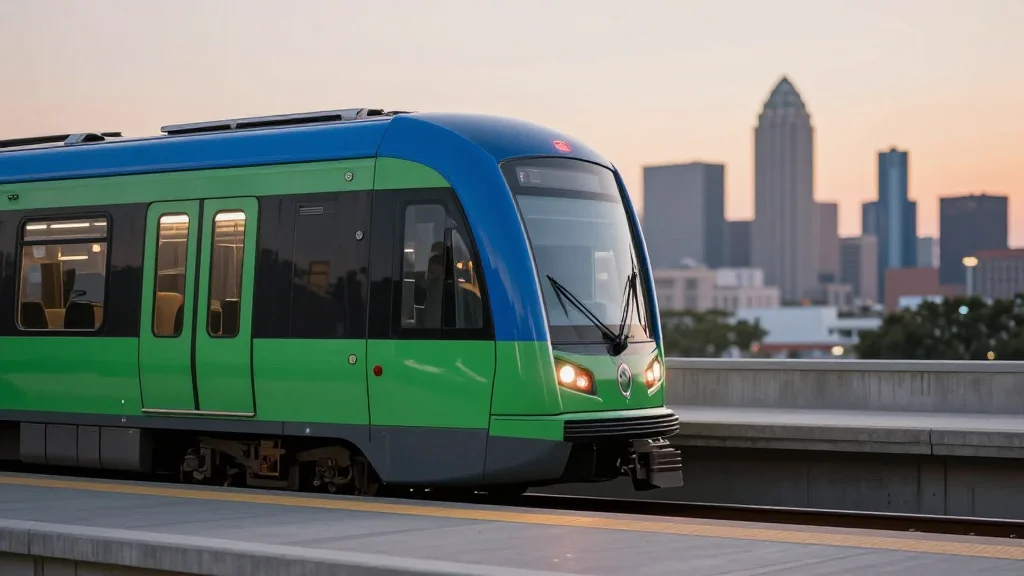
TX: Here's How DART Is Trying to Close Dallas' Commuting Gap
Why It Matters
DART’s ability to close the commuting gap directly affects low‑income residents’ access to jobs, education and health services, making its financial sustainability a regional economic priority. Without coordinated investment, transportation barriers will continue to limit workforce participation in North Texas.
Key Takeaways
- •DART serves 56 million trips annually across 700 sq mi.
- •Revenue relies on a 1% sales tax covering two‑thirds of budget.
- •Transform program invests $2.5 billion to replace vehicles and upgrade stations.
- •Service gaps persist for low‑income riders in south Dallas.
- •Regional coordination needed to match transit with employer shift schedules.
Pulse Analysis
Dallas Area Rapid Transit is at a crossroads as it balances rapid ridership growth with a financing model that hinges on a modest 1 % sales tax. The agency’s $2.5 billion Transform initiative, funded largely through existing tax revenue and bonds, aims to modernize a fleet that has aged beyond its design life and to retrofit stations with safety technology. Early results show a dramatic drop in missed trips—from roughly 15 % to under 1 %—and a modest decline in violent incidents, signaling that targeted capital spending can improve reliability and public perception even under fiscal strain.
The broader challenge for DART lies in aligning service patterns with the geographic distribution of jobs. North Texas’ employment centers are heavily clustered north of Interstate 30, while many low‑income residents live in the southern suburbs where service frequency remains limited. Experts argue that a data‑driven, regional approach—such as increasing bus frequency during peak shift changes rather than maintaining uniform intervals—could unlock access to logistics, construction and manufacturing roles that currently sit beyond reasonable commute distances. Such alignment would also support the city’s economic diversification goals by ensuring that the labor pool can reach emerging growth sectors.
Political dynamics add another layer of complexity. Recent votes in affluent municipalities like Addison and Highland Park on potential DART withdrawal underscore the delicate balance between tax contributions and perceived service value. As the agency confronts debt obligations extending into the 2030s, collaborative funding mechanisms—state grants, employer‑sponsored transit passes, and public‑private partnerships—may become essential. Ultimately, DART’s success in closing Dallas’ commuting gap will hinge on its ability to secure sustainable financing while delivering a transit network that mirrors the region’s evolving employment landscape.
TX: Here's how DART is trying to close Dallas' commuting gap
Comments
Want to join the conversation?
Loading comments...