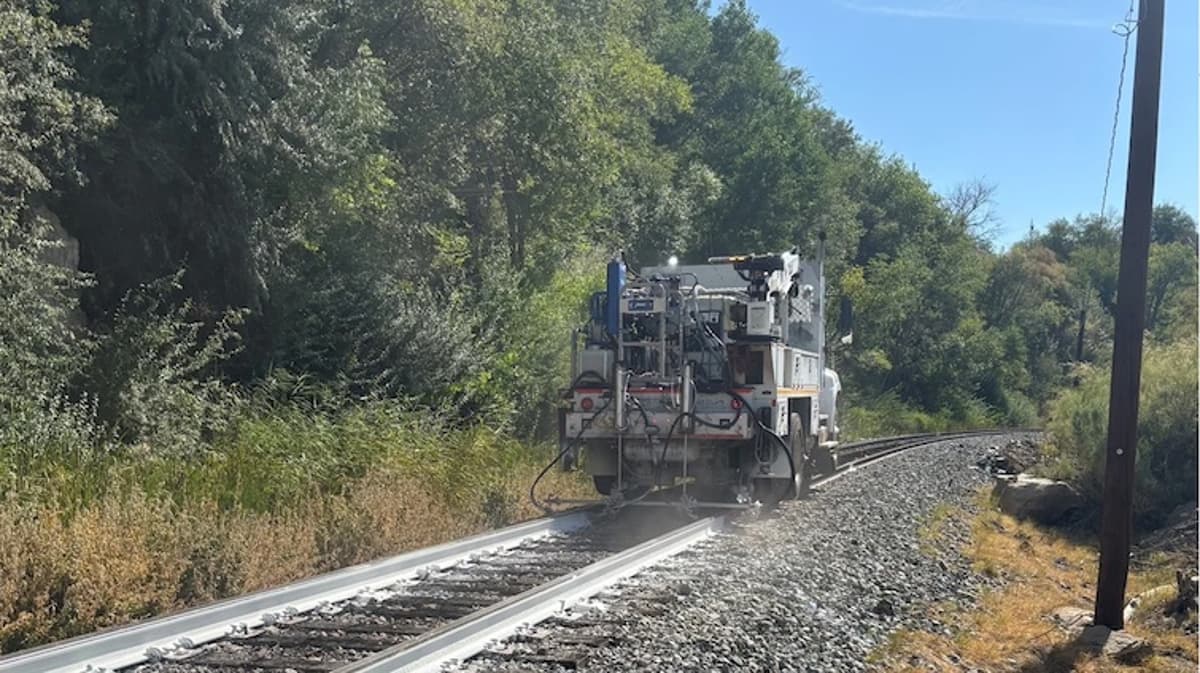
UP’s Solution to Heat-Related Track Conditions
Companies Mentioned
Why It Matters
Reducing rail temperature helps prevent thermal misalignment, a leading cause of summer derailments, thereby boosting safety and reliability across UP’s 32,000‑mile network. The approach could set a new industry standard for heat mitigation.
Key Takeaways
- •UP paints rails white to reflect sun, cutting surface temperature
- •Technique yields roughly 20 °F (≈11 °C) temperature reduction on rails
- •First U.S. railroad adopting European white‑paint rail method
- •Part of broader safety plan that delivered best‑ever derailment rate
Pulse Analysis
Heat is a persistent adversary for railroads that operate across the United States’ vast climate zones. When ambient temperatures climb, steel rails expand; if the expansion cannot be accommodated, the track can shift laterally, creating a thermal misalignment that weakens wheel‑rail contact and raises the risk of a derailment. The problem intensifies on long, straight stretches of track where there is little shade, and it has become a seasonal safety focus for Class I carriers. Historically, railroads have relied on speed restrictions and rail grinding to manage the issue, but those measures are reactive rather than preventive.
Union Pacific’s latest mitigation strategy borrows from two proven playbooks. In Europe, rail operators have long sprayed white, heat‑reflective paint on rails to keep surface temperatures down. In the United States, highway crews use a similar white‑striping process to improve road visibility. UP combined the two by deploying high‑rail trucks equipped with paint sprayers to coat both sides of each rail with a reflective white layer. According to chief safety officer Rod Doerr, the coating produces roughly a 20 °F (≈11 °C) temperature drop, which translates into measurable reductions in thermal stress during the hottest weeks.
The immediate impact is evident in UP’s safety metrics: the railroad reported its best‑ever full‑year derailment incident rate last year, a milestone it attributes in part to the new paint program. Beyond safety, the technique offers operational benefits such as fewer speed‑restriction orders and lower maintenance costs associated with rail buckling. If the cost‑effectiveness holds, other Class I carriers may adopt the practice, potentially establishing a new industry standard for heat mitigation. The move also underscores how incremental innovations, when scaled across a 32,000‑mile network, can deliver outsized returns for reliability and shareholder confidence.
UP’s Solution to Heat-Related Track Conditions
Comments
Want to join the conversation?
Loading comments...